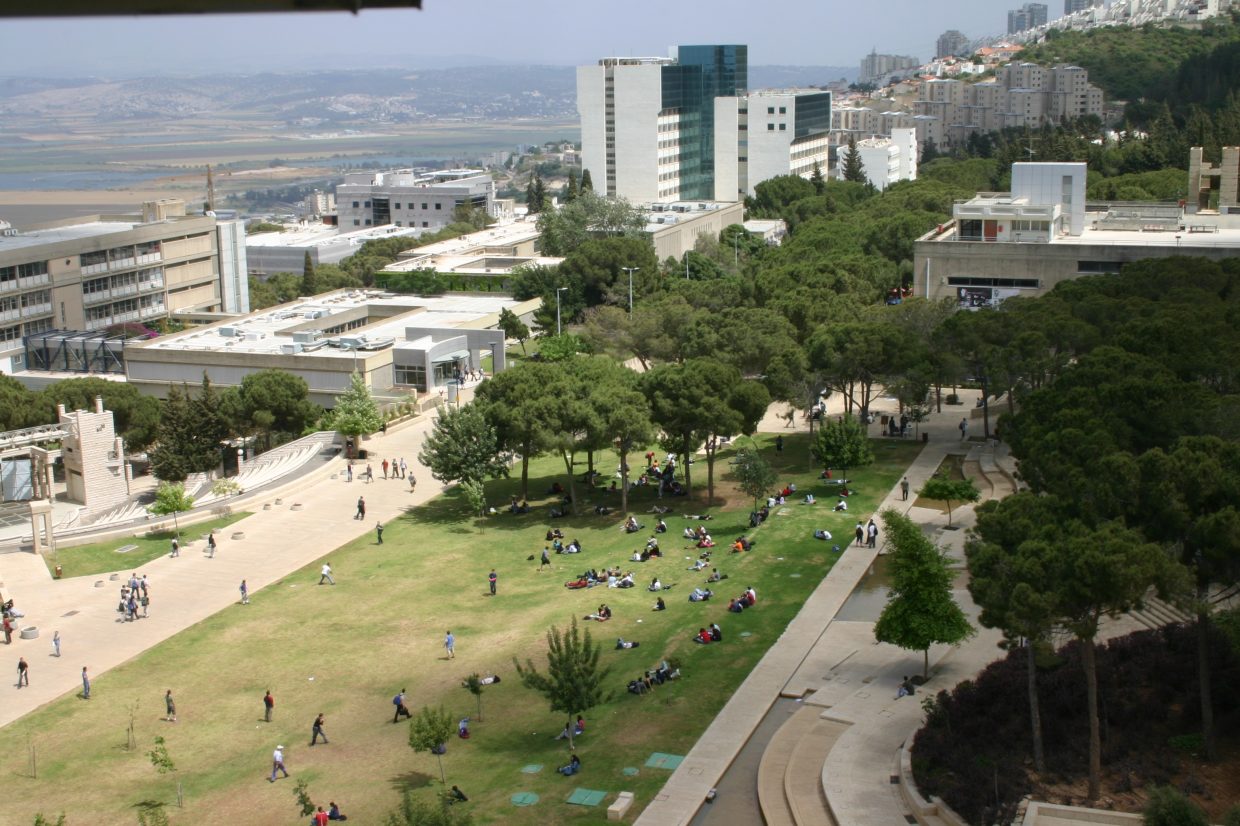
It is no secret that Israel has a reputation for being an incubator for some incredible innovations. The innovations discussed here are a mix of the old and the new technologies that are being integrated into worldwide use. Starting with the small items and moving to the largest technological advances, we will take a look at some top life-saving tools. The above picture is the Haifa campus of the Tecnion university, where many innovations are born.
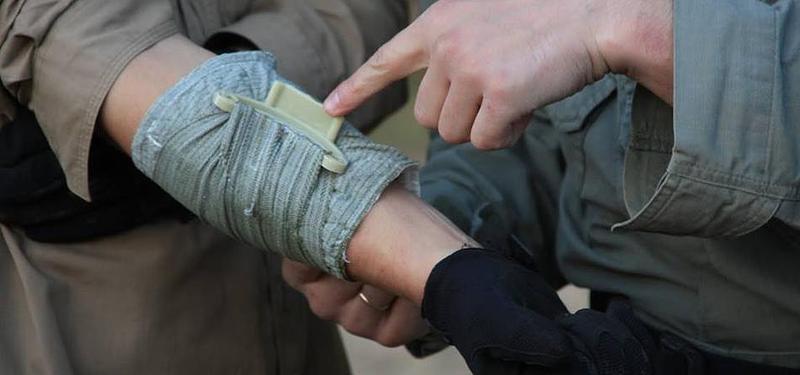
The Emergency Bandage in use.
The invention of the Emergency Bandage came as a random thought spurred by a standard training bandage handed out to IDF medic-in-training Bernard Bar Natan. Bar Natan noticed that the bandage had a production date of 1942 and mused that so many things in the Army had been upgraded and improved upon, and yet the bandage that would be used in life-threatening and potentially life-saving situations, had remained unchanged. It would be 12 more years before his thought turned into a bandage that was used in a NATO peacekeeping operation in Bosnia and Herzegovina in 1996.
This revolutionary bandage is used in many militaries around the world and carries the nickname, “the Israeli bandage” that the American military first coined. One of the main concerns with any serious wound is blood loss and the ability to stop it. Prior to this bandage, different methods were used to pressurize a wound in the field and then transport the wounded to a hospital as quickly as possible. The unique features of this bandage have the ability to pressurize the wound, significantly reduce the flow of blood, and lock into place without the need for anything more. Having the sterile wound bandage, the outer wrapping and the pressure clip all integrated into one saves space, expense and most importantly, time. This is especially true when dealing with a hemorrhagic wound that could cause death through too much blood loss.
Another cutting-edge technology from the Israeli battlefield was used in the IDF’s field hospital in Kathmandu, Nepal during the earthquake in 2015. Freeze-dried blood powder was quite literally a life-saving tool in the medic’s hands. The powder can be mixed with water to give transfusions. “If you are taking plasma for patients you have to keep it frozen or it won’t survive. With this, you just add water and it’s like fresh plasma. We’ve used it in other missions and it’s very helpful,” reported Col. Dr. Ofer Merin, medical commander of the Kathmandu IDF field hospital in an interview with Israel 21C, an online news magazine. This innovation was developed in Israel with a joint partnership between the IDF Medical Corps and Core Dynamics, an Israeli biotechnological company, that has ongoing research and development in the field of thawing and freeze-drying technologies in blood transfusions. During the press statement at the beginning of this research in 2009, Brig.Gen. Dr. Nachman Ash head of the medical corps, also stated that once it was proven, it would most likely be developed for civilian use as well.
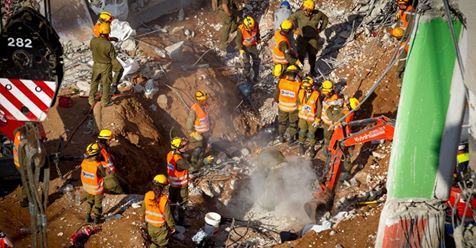
Res-Q-Cell can significantly aid Search and Rescue workers in disaster situations.
Res-Q-Cell locates survivors trapped in wreckage by issuing signals that activate their cellular devices. It was first introduced in 2016 by the Israel Aerospace Industries and works by sending a signal over an area up to 100 square meters that activates cellular devices. After activating it then detects their signals, identifies their owners, and can geo-locate them to within a meter. The system works even when a cellular network is downed. As a life-saver, it could have a serious impact.
The technology was used for the first time in September 2016 to locate and recover victims of a collapsed four-story underground parking garage in Tel Aviv. In an interview with The Times of Israel during rescue efforts, the head of the Jerusalem and Central District of the IDF Home Front Command, Colonel Ramtin Sabti, said Res-Q-Cell’s level of precision was significantly higher than cellular locators used up until then. The IAI has said the system, “can be tailored to specific areas or country requirements and is designed to work in different scenarios including natural disasters, building fires, and terrorist attacks.” It sure makes a compelling reason to keep that phone handy!
In the wake of 9/11 and other similar disasters, an alternate way to escape tall buildings was needed. Israeli innovation went to work and devised the SkySaver Rescue Device or Window Escape Pack as it is sometimes called. The Israeli company, also called SkySaver, created a portable escape system equipped in a simple-looking backpack. It is not a parachute but a mechanism that will lower a single person to the ground safely at a controlled speed. This product can be installed in high-rises and can carry up to 260 lbs or 120 kg according to their website. The backpack contains 80, 160, or 260 feet of cable that helps an individual descend from a window. The cable system in the backpack attaches to a secure anchor point that has been pre-installed by a professional and allows a safe descent of up to 2 meters per second. Simply strap on the backpack securely according to the instructions, clip the carabiner to the anchor and exit the window. The weight of the person will activate the system and it won’t stop until you reach the ground or the cable runs out. It may not be an answer to all the high rises in the world but it is a life-saving technology that we think is much needed.
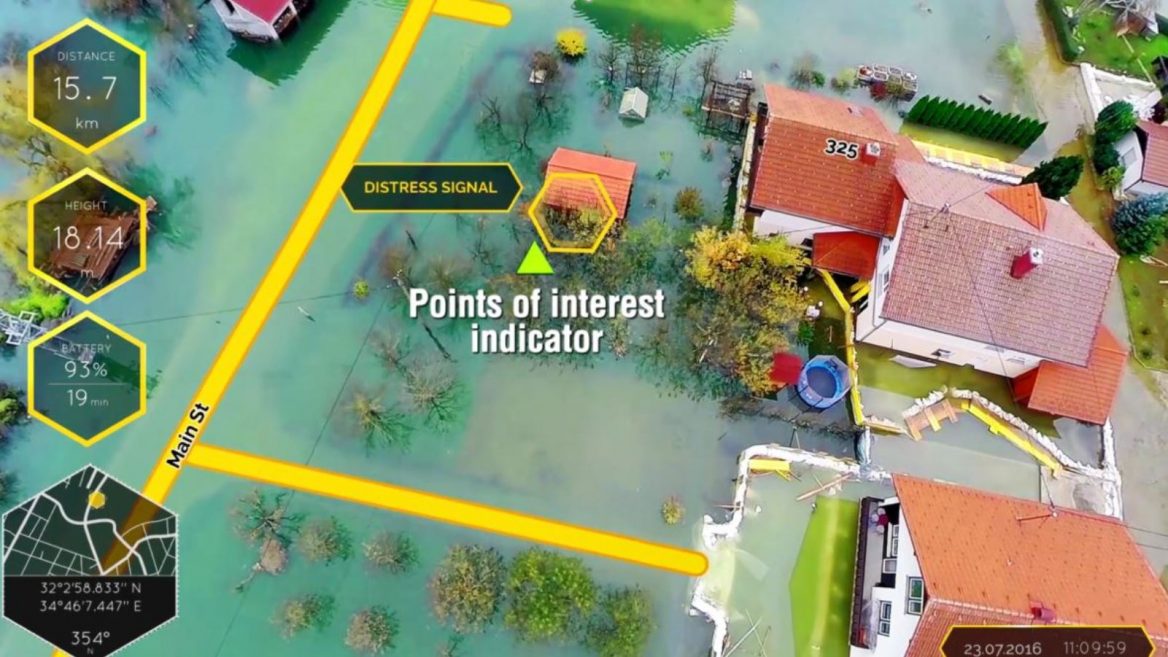
First Response App simulation.
The most recent addition to this list began when an Israeli dad got hooked on drones and decided to film his daughter as she surfed. During this time, the idea struck to create a racing game for drone users. So Adam Kaplan, and his friend, Menashe Haskin, teamed up in 2016 and developed the game in partnership with DJI drone company. Shortly thereafter, Kaplan, a former executive of a few successful technology companies, was approached by DJI and authorities from American fire and police departments about adapting the technology for real environments.
Drones were already being used in hundreds of police stations in the US but needed the “mapping over video” that the game had. So the inventors set to work tailoring their software, named First Response, as a life-saving app working with that focus in mind. Quickly they had a real-life field test thrust upon them with the start of hurricane season in Florida. Hurricane Irma’s subsequent arrival in the Florida Keys in September of 2017 was the first use of the app in the field. The app allows the pilot to view street names and identifiers such as buildings and homes, laid over the image the drone is recording. This gives workers the ability to orient themselves and have a layout of their immediate area. An incredibly helpful tool when once recognizable landmarks were obliterated in Hurricane Irma. “What started as technology powering a racing game is now saving lives around the world,” remarked Kaplan in an interview with Israel21c.
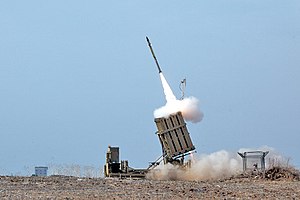
Iron Dome in action.
Lastly, one of the largest and possibly most well-known of Israeli innovation is the Iron Dome. This life-saving technology tracks incoming rockets or artillery shells and fires a counter-missile to destroy the projectile harmlessly in flight. It is a highly mobile technology and moves quite often depending on the intelligence and threat level. The system operates a radar that, along with mathematical algorithms, identifies the type of incoming projectile, maps its trajectory and determines if it will hit a populated area. If it determines it is a threat to the human population, it will deploy a counter-missile. It was developed by an Israeli firm, Rafael Advanced Defense Systems along with Israel Aircraft Industries. Making its debut in early 2011, it has racked up quite an impressive record of intercepts. The reports show a 90% intercept rate and you cannot deny the security it has brought to many citizens that used to live with constant anxiety and now sleep much easier.