Name-calling Israel an Apartheid state has nothing to do with truth and everything to do with trying to destroy Israel by other means. It’s not working!
If the enemies of Israel were parties in a traditional duel and asked “Choose your weapon”, no prize what they would choose. It would be the lie that “Israel is an Apartheid State”. In truth – it is a poor choice. They would be firing blanks!
With every Arab country having laws against Palestinians – that is Apartheid!
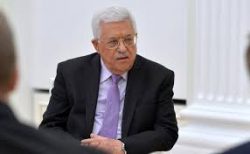 When Mahmoud Abbas said in July 28 2010 to the Egyptian media that “I will never allow a single Israeli to live amongst us on Palestinian land” – that is Apartheid.
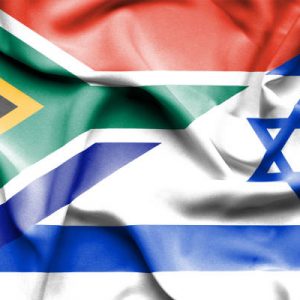
With Israel defying the odds and becoming stronger each year, it approaches its 70th birthday in 2018 with an enviable reputation as the “Startup Nation” and Cyber Capital of the world. With Israel enjoying an advance space programme, spending 4.5% of its GDP on Research & Development (R&D) – the highest in the world followed by the USA at 2% – South Africa is battling to provide water for its people. At the time of writing, Cape Town has less than 100 days of water, and yet BDS in South Africa, having nothing credible to attack Israel with, defames it by calling it “an Apartheid state”.
This allegation, like the situation in South Africa, does not hold water!
But why should people believe this nonsense? Some might if they have little or no knowledge about Israel.
So, when someone with the stature of Benjamin Pogrund says “Israel Is Nothing Like Apartheid South Africa” one should take notice.
Appearing as an op-ed in the New York Times (March 3: ‘Why Israel is nothing like apartheid’), Pogrund writes, “Among critics of Israel, it has become ever more common to accuse the Jewish state of imitating apartheid South Africa. This month, an obscure United Nations agency, the Economic and Social Commission for Western Asia, whose membership comprises 18 Arab states, caused an uproar when it issued a report accusing Israel of applying the same racism in its conflict with Palestinians that made South Africa an international pariah. The United Nations secretary general swiftly repudiated the report, and it was removed from the agency’s website.”
The idea of falsely labelling Israel an apartheid state “is a staple of BDS (the Boycott, Divestment & Sanctions movement), which has made the South African comparison practically the lingua franca of anti-Israel activism. But announcing it loudly and ceaselessly, as the movement does, doesn’t make it true.”
On the contrary, it exposes BDS as a lying manufacturing machine!
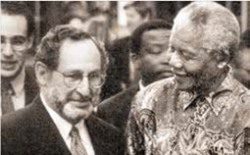
No Longer Meeting in Secrete. Former Deputy-Editor of the Rand Daily Mail Benjamin Pogrund with Mandela shortly after his release in 1994.
Look Who’s Talking
Pogrund’s liberation credentials are impeccable.
Spanning a career of reporting on Apartheid, Pogrund was frequently investigated by South Africa’s security police, put on trial several times, experienced prison once, and had his passport revoked. Today the former Deputy-Editor of the Rand Daily Mail is the director of Yakar’s Center for Social Concern in Jerusalem which he founded, and so having lived in both countries – and still a feisty liberal – is in a position “to know the difference.”
Pogrund enjoyed a close relationship with the late Mandela. Following the passing of South Africa’s first democratically elected president in 2013, Pogrund spoke to me about this relationship that transcended time and turmoil.
“Prior to his capture in August 1962, Mandela’s life had become a game of cat and mouse. We set up secret meetings by sending messages through trusted people. We met at the home of Adelaide and Paul Joseph near Joburg’s city centre, or I parked my car at night in a dark spot in a quiet street, and Mandela would appear. His disguise – which did little to conceal him – was a worker’s boiler suit.”
What struck Pogrund was “how he projected such purpose and determination.”
Many years would pass before Pogrund again met Mandela. “I kept applying to visit him in prison and was refused. Then, out of the blue, it was agreed. I was to be allowed to see him as a friend – not as a journalist – and had to promise not to write anything.
“In the interview room, on the other side of a large sheet of glass, in walked Nelson: his hair grey, his face lined, but looking in good health and as imposing as ever.”
Pogrund sensed a change about the man. “Although he was the same warm and friendly person I had known all those years before, there was now an added gravitas to him. He had come through the fire, and was steeled and strong. I noted that he had an authority unusual in a prisoner.” In all the years working for The Rand Daily Mail, “I had never come across a prisoner whose attitude and behaviour were not that of a prisoner. On a subsequent visit with my wife, the prison’s officer in the room deferred to him. When we were saying goodbye in the entrance hall, it was hard to believe that this was a man who was going to be locked in that night.”
It would be another four years before Mandela was released.
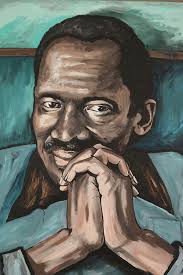
Robert Sobukwe
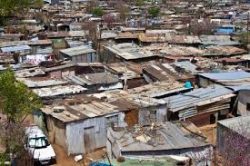
Soweto
No Comparison
So why, asks Pogrund, does the Apartheid comparison not stack up?
“Apartheid in South Africa maintained privilege for the white minority and doomed people of color to subservience; it determined every aspect of life — the school you attended, the work you did, where you lived, which hospital and ambulance you used, whom you could marry, right down to which park bench you could sit on without facing arrest. I know this because I lived it.”
Starting at The Rand Daily Mail in 1958, Pogrund pioneered like a ‘Trojan Horse’, covering comprehensively black life in the mainstream press – “the arrests every year of more than 350,000 black people who transgressed the “pass laws” that controlled where they were permitted to live and work; starvation in the rural areas, with babies dying from severe malnutrition; awful housing, transportation and health care; torture by the security police and detention without trial.”
This was Apartheid South Africa.
For more than a quarter-century, he reported and analyzed “the evils of apartheid.” Through his work, he became friends with black leaders. “Apart from Nelson Mandela of the African National Congress, also Robert Sobukwe of the Pan-African Congress. With my editor, the renowned Laurence Gandar, I spent four years on trial for my reports about abusive prison conditions. I was denied a passport for five years.”
Pogrund would suffer for his stand against Apartheid!
Moving On
When 1985, The Rand Daily Mail was closed under pressure from the government, he could not get a job, and sought sanctuary in the UK as a Fleet Street journalist. Following an invitation to start a dialogue center in Jerusalem, he moved there with his wife in 1997, and for the next 12 years sought to bring people together, notably, Israelis and Palestinians. In all this time to the present, Pogrund has researched and written extensively about the country that “has become my second home.”
Remaining committed to both Israel and South Africa, and straddling both societies, “I am acutely aware of Israel’s problems and faults, but it is nothing like South Africa before 1994. Those who accuse Israel of apartheid — some even say, “worse than apartheid” — have forgotten what actual apartheid was, or are ignorant, or malevolent.”
For BDS and its supporters, it is probably an amalgam of all three.
Comparing life under Apartheid, “Israeli Arabs have the vote, and enjoy full citizen rights. The Supreme Court has an Arab judge; the head of surgery in a leading hospital is Arab, and Arabs head university departments. In hospitals and clinics, Jewish and Arab doctors and nurses, secular and religious, work together, giving care equally to Jewish and Arab patients — all unthinkable under apartheid.”

Rawabi a planned city built for and by Palestinians. in the West Bank
The West Bank Conundrum
While Pogrund describes the West Bank and East Jerusalem – which Israel captured in a defensive war from Jordan in 1967 – as “an occupation”, he writes “both sides fouled up.” He levels most the blame on the Palestinians “who stepped up terrorist attacks,” after the Oslo Peace Accords in 1993, “helping to drive many Israeli Jews to the right.” In the absence of a peace agreement, Israel continued to build settlements and with “some 600,000 Jews now living in the West Bank and in East Jerusalem,” this does lay Israel open to the accusation “for undermining the two-state solution.”
Pogrund takes issue with the BDS movement over what it calls the “apartheid wall” which “was erected between Israel and the West Bank for security reasons, primarily to keep out would-be suicide bombers.” While “ugly …. it has nothing to do with apartheid-style racial segregation.”
While not holding back his belief that “occupation is an oppression,” and that “No rule over an unwilling and resistant people can be pleasant,” there is still a monumental distinction.
Clearly, he emphasises, “there is none of the institutionalized racism, the intentionality, that underpinned apartheid in South Africa.” So why does the B.D.S. pursue a path of propagating patent lies?
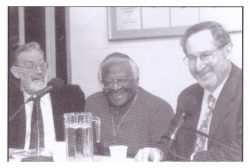
Talking Heads. Participating in a discussion at the Yakir Center for Social Concern in Jerusalem is (l-r) Dr. Micki Rosen,South Africa’s Nobel Peace Laurette and retired Anglican Archbishop, Desmond Tutu, and the Center’s Director, Benjamin Pogrund
Truth Laid Bare
Founded by Palestinians in 2005,” the BDS movement,” writes Pogrund, “has spread internationally,” embracing “a heterogeneous alliance of Muslims, Christians, anti-Zionist Jews, right-wingers and left-wingers.” Most evident is the “Anti-Semitism … among certain BDS supporters.”
While the movement points to the success of boycotts in bringing an end to Apartheid, that belief, “is simplistic and mistaken.”
During the many years of struggle for freedom in South Africa, “the African National Congress, now in government, refrained from violence against white civilians, with very few exceptions. This was, in large part, a strategic decision to avoid scaring whites into a refusal to yield power. Suicide bombings and murders by ramming pedestrians with vehicles never happened in South Africa. Yet Israel has had them aplenty. Security concerns have dictated Israel’s precautions and responses, not an ideology of apartheid racism.”
The most deceptive of the B.D.S. movement’s demands, asserts Pogrund, is for the return of Palestinians who mostly fled Israel in the 1948 war.
“What few people realise,” says Pogrund is that “uniquely among the world’s 65 million refugees – the Palestinians’ descendants are defined as refugees. The original 750,000 Palestinian refugees now number six to seven million. A mass return would destroy Israel as a Jewish state – which is the whole purpose of its existence!”
Sacred Cow
Clearly, the aim is the destroy Israel by a flood of ‘refugees’, who by the standard definition, applies to no other group. The name of the Palestinian game is ‘victimhood’ and they are milking it until the cows come home.
Pogrund concludes that, “South African apartheid rigidly enforced racial laws. Israel is not remotely comparable. Yet the members of the BDS movement are not stupid. For them to propagate this analogy in the name of human rights is cynical and manipulative. It reveals their true attitude toward Jews and the Jewish state. Their aims would eliminate Israel. That is what’s at stake when we allow the apartheid comparison.”
While BDS advocates might not be “stupid”, clearly, they are banking on their supporters being ‘stupid’ to believe them!