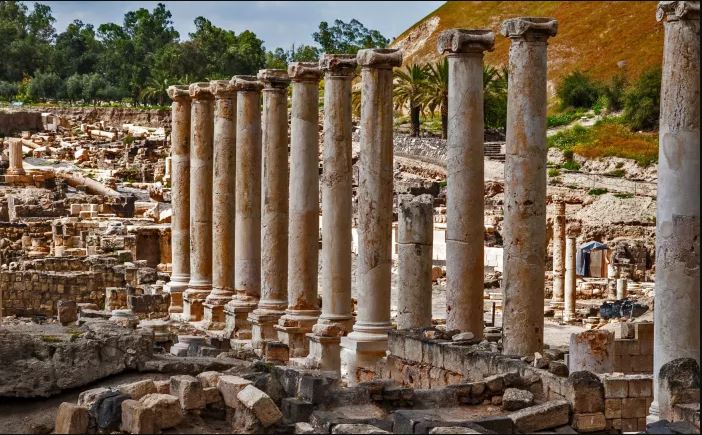
Carpeting Europe’s verdant landscape are majestic castles alluring tourists by their magnitude, splendor and history. South African TV viewers of the 2017 Tour de France would have noticed some of these impressive castles, fortresses and splendid Chateaus along the route watching out for their cycling compatriots – Janse van Rensberg, Jaco Venter and Louis Meintjies.
While most these superlative structures were built during the Middle Ages, Israel’s more ancient stone battlements – far more weathered from the ravages war – are no less illuminating in revealing the region’s fascinating history.
JAFFA
While Tel Aviv today is thought of as a young brash city, its architecture articulating the modern age, only a few kilometers either to its south or to the north, we find remnants of fortresses of the ancient world.
Jaffa, thought to be the oldest port in the Mediterranean, naturally had to be protected from attack, although its ramparts were not always successful. Walk near the seafront and one will pass the walls that were breached by Napoleon’s soldiers in 1799. The French emperor however, followed a long list of Jaffa’s conquerors that goes back to the Egyptian Pharaoh Thutmose III in the 15th CBC, who took the city by trickery. Pharaoh’s general, Djehuty, hid his armed Egyptian warriors in large baskets which he sent as a present to the Canaanite city’s governor, who clearly had not read the classics. Unfamiliar with Homer’s Iliad and the Trojan horse, he never heard the expression ‘beware of Greeks bearing gifts’. Sadly, for Djehuty, he and his defenders went the same way as the hapless Trojans!
Godforsaken
Fortress of Arsuf (Apollonia)
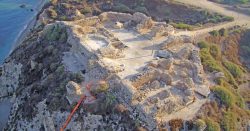
Only 15 kilometres north of Tel Aviv, on a cliff above the Mediterranean Sea is the ancient city and fortress of Arsuf (also known as Arsur or Apollonia.) Why three names? Well, like so much in the “Holy Land” the answer ‘lies with the gods’ or as most tour guides will tell you, “depending – whose gods”.
While during the Phoenician era in the 6th century BC, the town was named Arshuf after Resheph, the Canaanite god of fertility, it was during the Hellenistic period that the anchorage town was renamed Apollonia, as the Greeks identified the Phoenician God Reshef with Apollo. And then came the Crusaders, who in 1101 under Baldwin I of Jerusalem, conquered the city, rebuilt its walls and renamed it Arsur.
The town is best remembered for the famous Battle of Arsuf during the Third Crusade when Richard the Lionheart of England defeated Saladin – only one of their many medieval clashes. Unlike European castles that have for the most past survived the ravages of warfare, the conquerors in the Middle East were less forgiving. In 1265, Sultan Baybars, ruler of the Mamluks, captured Arsur and after forty days of siege, razed the city walls to their foundations, fearing the Crusaders would return.
City of Dreams
Caesarea
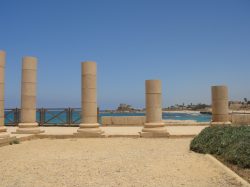
Not too far north is the walled ancient port city of Caesarea founded in the first century BCE by King Herod, known as ‘The Master Builder’. A ‘dreamer with a difference’, Herod literally built his dreams!
Named after Augustus Caesar, it was a walled city with the largest harbor on the eastern Mediterranean coast. “We have over 800,000 visitors a year crossing this moat,” says Vered Cohen, Head of Events and Activities at the Caesarea Harbor. Vered met the writer on the bridge over the moat which once impeded invading armies. Entering through an imposing medieval gate built by the French Crusader King Louis IV, Vered explained that “this Gothic serpentine entrance was designed to slow down visitors. You cannot walk in straight – you have to turn left and then right, making it difficult for those with hostile intent to mount a successful attack.” There are no such concerns today as the last battles fought in Caesarea were in 1948 during the War of Independence. “Today, our invading armies are tourists,” delights Vered. As we speak, walking along the cobbled road leading into the center of the town, a large group of American tourists pass us. “Back in the days of Herod,” says Vered, “there would have been Roman chariots careering past us. The streets would have been bustling with traders and women doing their shopping for fresh fruit, vegetables, fish and livestock. Romans would be attired in their togas as they proceed to the temple to pay tribute to their gods or to the baths where their intentions were more temporal than spiritual.”
Bravado at Balvoir
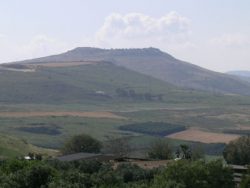
Horns of Hittin
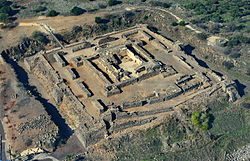
Belvoir
For those with a keen interest in Crusader architecture, “a visit to ) is a must,” says renowned tour guide Adrian Wollf, originally from Johannesburg, South Africa, and author of ‘A Chronology of Israel – A complete history from biblical to modern times.’ Perched on hill 20 kilometers south of the Sea of Galilee, Belvoir “is considered one of the best-preserved Crusader fortresses in Israel. Built by the Knights Hospitaller in the 12th century and strategically positioned 500 meters above the Jordan River Valley, it has commanding views in all directions.” Wolff quotes from Abu Shama who wrote of Belvoir as “Set amidst the stars like an eagle’s nest and abode of the moon”. Following Saladin’s victory over the Crusaders at the battle of the Horns of Hittin, Belvoir was besieged for a year and a half, until the defenders surrendered on the 5 January 1189. The fortifications of Belvoir were later dismantled by the Muslims who typically feared the reconquest of the fortress by the Crusaders.
“What is of architectural interest”, says Wolff, “was the concentric design used at Belvoir that influenced fortress design for the next several centuries.”
Off the Beaten Track
As castles were constructed mainly for protection, they share a similarity with property today in that “location is everything”. However, property developers then, as today, sometimes get it wrong. The ruined crusader castle, Montfort, 10 miles south of the Lebanese border is a case in point, according to Wolff “as it was constructed off the beaten track and so was not terribly useful in protecting trade routes and travelers.” Even today, it is off ‘the beaten track’, as you cannot drive up to it and must proceed a few kilometers on foot. “To visit this Teutonic Knights fortress, you need to be keen and energetic. Nevertheless, it is well worth it.” Sitting majestically, 180 metres above the Kziv River, one of the few all-year running rivers in Israel, it is literally “in the middle of nowhere,” but offers “spectacular views of the Western Galilee.”
The name of the fortress derives from the two French words mont (a mountain) and fort (strong), meaning the “strong mountain”.
The Mamluk leader Baybars (1223-1277) besieged the fortress in 1266. Although not built for warfare, the defenders of the fortress resisted fiercely and eventually compelling the Mamluk invaders to leave. They bided their time!
Five years later, after most of the Crusader strongholds had fallen into Baybars’ hands, the Mamluk leader returned to the fortress in 1271, and toppled the fortress’ external southern wall using several military engineering battalions. After fifteen days of siege, the Teutonic Knights surrendered. Due to prior negotiations between Baibars and the Crusaders, the latter could leave the fortress with all their belongings and return to Acre. “After the fall of Acre in 1291, the Teutonic Knights made Venice their headquarters,” revealed the guide.
Allure of Acre
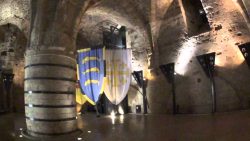
Acre
Easily accessible, and probably one of the most important fortresses historically, is the walled city of Acre located midway between Haifa and Nahariya.
Conquered by many notable and colorful invaders, the most celebrated failures was Napoleon. “A total blunder,” explains tour guide Wolff. “The walls of Acre are 10 meters high and Napoleon came along with 5-metre-high ladders. The attack against the Turkish warlord Ahmed el-Pasha (nick-named el-Jazzar, the butcher) was a non-starter.” Many of the abandoned French weapons are on exhibit in the Nautical Museum at Dor, south of Atlit along the Carmel Coast.
The most important coastal city during the Crusader period, Acre fell without a fight to Saladin in 1187. This followed his great victory at Hattin and his conquest of Jerusalem. “He was clearly on a roll,” explains Wolff. “The momentum was with him until the arrival of England’s Richard the Lionheart, who recaptured Acre in 1191and then took time out to watch over three days, the beheading of his Muslim prisoners.” Acre remained the final stronghold of the Crusader state, until “the new kid on the block – the Mameluks of Egypt – captured it in a bloody siege in 1291.”
Some thirty years later, the biographer Abu’l Fida lamented that while Acre remained “a beautiful city,” it was “still in ruins”.
Today, it is “its ruins” and its turbulent history that makes a visit so Acre so worthwhile.
Under the Stars
One of Wolff’s favorite castles for taking overseas visitors, “because it’s so beautifully restored and easily accessible,” is Yechiam, at Kibbutz Yechiam. Ten miles due east of Nahariya, the 12th century Templar fortress was destroyed by the Mamluk Sultan Baybars in the late 1200s, only to be rebuilt in the 18th century by the local Bedouin warlord, Sheik Dahr El-Omar.
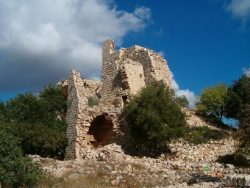
Yechiam
Although a ruin, “it nevertheless enjoyed habitation as recently as the late 1940s when the first kibbutz members, many of them survivors from the Holocaust, lived within the ancient walls in tents,” explains Adrian. Primarily built for protection against enemy attack, ancient Yechiam was to again come under attack – in modern times! During Israel’s War of Independence (1948-1949) a massive barrage of fire from Arab troops entrenched in the hills surrounding the fortress, “struck the fortress walls and outposts, killing several Kibbutz members.” The worst of the fighting took place on March 27, 1948, when a convoy sent to reinforce the kibbutz was ambushed and 47 Jewish fighters were killed. Today, Yechiam is known as a romantic evening spot where young folk wander under the stars through the ruins of the castle, their sights set more on the future than the past.
High in the Hermon
No first-time tour of the Golan Heights is complete without a visit to Nimrod Castle, which offers spectacular views of the Hula Valley, the Upper Galilee, the Golan Heights, Mount Hermon and the mountains of Lebanon.
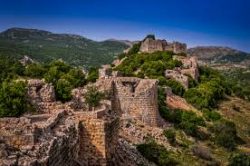
Nimrod Castle
“Its strategic importance,” says tour guide Danny Leuchter, “is that it guarded the ancient trade route from Tyre to Damascus.” While most of the medieval fortresses in Israel were built by the Crusaders to protect the terrain against the Muslims, “Nimrod was the opposite – built around 1229 by Al-Aziz Uthman, nephew of Saladin, to prevent Crusader expansion, which had reached the valley below.”
However, explains Leuchter, “following the Muslim conquest of Acre and the end of Crusader rule in the Holy Land, Nimrod lost strategic value and fell into disrepair.” It’s only action in recent times was when the word ‘action’ was bellowed by director, Joseph Cedar of the 2007 Oscar nominated Israeli war movie ‘Beaufort’. Although the film is set at Beaufort castle in South Lebanon, Nimrod, with its fine medieval walls, offered an ideal substitute.
The fortresses’ splendor has impressed visitors over the years, most notably Mark Twain who visited the Holy Land in 1867 and published his impressions in ‘Innocents Abroad’. Although mostly critical with what he saw in the Holy Land, he nevertheless said of Nimrod that “This is probably the most exquisite ruins in the world.”
Israel’s ‘Battle of Midway’
Midway between Tel Aviv and Jerusalem, near the national freeway that runs between the two cities is Latrun – a strategic hilltop fortress in the Ayalon Valley. Latrun is thought to take its name from a corruption of Le toron des chevaliers (the Castle of the Knights), once a Crusader stronghold in the area. Little however remains of the 12th century castle, once controlled by the Templars.
While the Ayalon Valley was the setting for many major battles in ancient Israel – namely where the Israelites under Joshua defeated the Amorites, and where Judah Maccabee established his camp before ambushing the Greek invaders – the site has been no less significant in determining the destiny of modern Israel. When the British withdrew in 1947, they handed over Latrun to the Arab Legion who blocked the road from the coastal plain to Jerusalem by shelling Israeli vehicles traveling below. This effectively imposed a siege on Jerusalem, and in the ensuing battle over Latrun – where former Israel Prime Minister Ariel Sharon was injured – the Arab defenders, enjoying the high ground, held on. In the end, a bypass road to Jerusalem known as the ‘Burma Road’ was built to relieve the besieged city of Jerusalem.
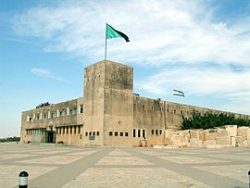
Latrun
It was not until the 1967 Six Day War, that Latrun was finally captured by the Israeli Defense Forces and the main road to Jerusalem was re-opened and made safe for travel.
Recording this strategic hilltop battlement through the millennia is an impressive museum, replete with weaponry used in the 20th century, which tour guide Leuchter says, “is a must.”
As with many other fortresses across Israel, the deeply pockmarked outer walls of the fort are a reminder of the building’s wartime past.
Jerusalem of Gold
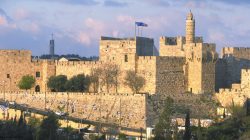
Tower of David
Despite Israel’s many fascinating and diverse castles, if a visitor had to chose only one to see “then I would advise the Tower of David in the Old City,” says tour guide Leuchter. “If you’re in Jerusalem, it’s a golden opportunity – the ‘Jewel in the Crown’.”
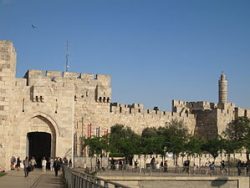
Jaffa Gate
The eye-catching ancient citadel, located near Jaffa Gate at the entrance to the Old City, was built during the 2nd century BC and subsequently destroyed and rebuilt by a succession of conquerors – Christians, Muslims, Mamluk and Ottoman Turks. “They each had a bash at bashing it,” laments Leuchter, “but there is no denying the origin. You can see today – the base is still Hasmonean,” referring to the dynasty established under the leadership of Simon Maccabaeus. “On top of it, King Herod built his castle which at the time consisted of three towers – not only to defend the city, but to safeguard his own royal palace. When the Romans sacked Jerusalem, they destroyed two of the towers and left the one we have today. They were hardly being gracious in victory, more likely showing off. By leaving the one tower intact – which by the way was much taller – the Romans were making a statement: “This was not some uppity outpost of our empire we just conquered, but mighty Jerusalem, the kingdom of the Jews!” We know much of their thinking at the time from the writings of Josephus.”
It was the Ottomans, who after installing a mosque at the site, added the minaret which still stands today. It was also during this time that the complex began to be called the ‘Tower of David’, so named after the founder-king of Jerusalem. “As one can see,” says Leuchter, “Jewish sovereignty of this turf, is embedded in its ancient masonry.”
In keeping with the long line of notable conquerors over the millennia, the 20th century added its own colorful collection of iconic images. One of the most famous is of General Edmund Allenby, who following his troops’ dramatic capture of Jerusalem from the Turks in The Great War, dismounts from his horse and enters Jerusalem on the December 11th, 1917 through Jaffa Gate. He does so on foot out of respect for the Holy City.
Of particular interest to South Africans as they enter the Old City through Jaffa Gate is the plaque on the left which reads:
“Restored by the generous help of South African Jewry.”
Lions at the Gate
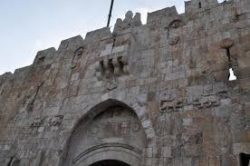
Lion’s Gate
For Jews, after 2000 years of exile, there are two iconic photographs taken during the Six Day War that stands out. Both have ‘walls’ as backdrops, but are rich in their profound symbolism. Firstly, there is the photograph of the three enlisted soldiers standing before and marveling at the recaptured Western Wall; they represent the ordinary Israeli, overwhelmed with joy at what they had accomplished. The other photograph is of their victorious generals – Uzi Narkis, Moshe Dayan and Yitzchak Rabin – in full battle fatigues, striding like proud ‘lions’ through the Old City’s Lion’s Gate.
Since then, the high-walled Old City has been at peace, the only invading conquerors being the millions of annual tourists, who flock into the famed Tower of David Museum.
They leave enriched – unlike Titus with loot – but with endearing memories.
And for true lovers of castles, visitors may ascend to the ramparts, where they will enjoy not only a 360-degree view of the city of Jerusalem – old and new – but a 4,000-year perspective of Jewish civilization from the time of the Bible to the modern era.
At least as a tourist visiting castles in Israel today, you don’t have to bring ladders like Napoleon!