
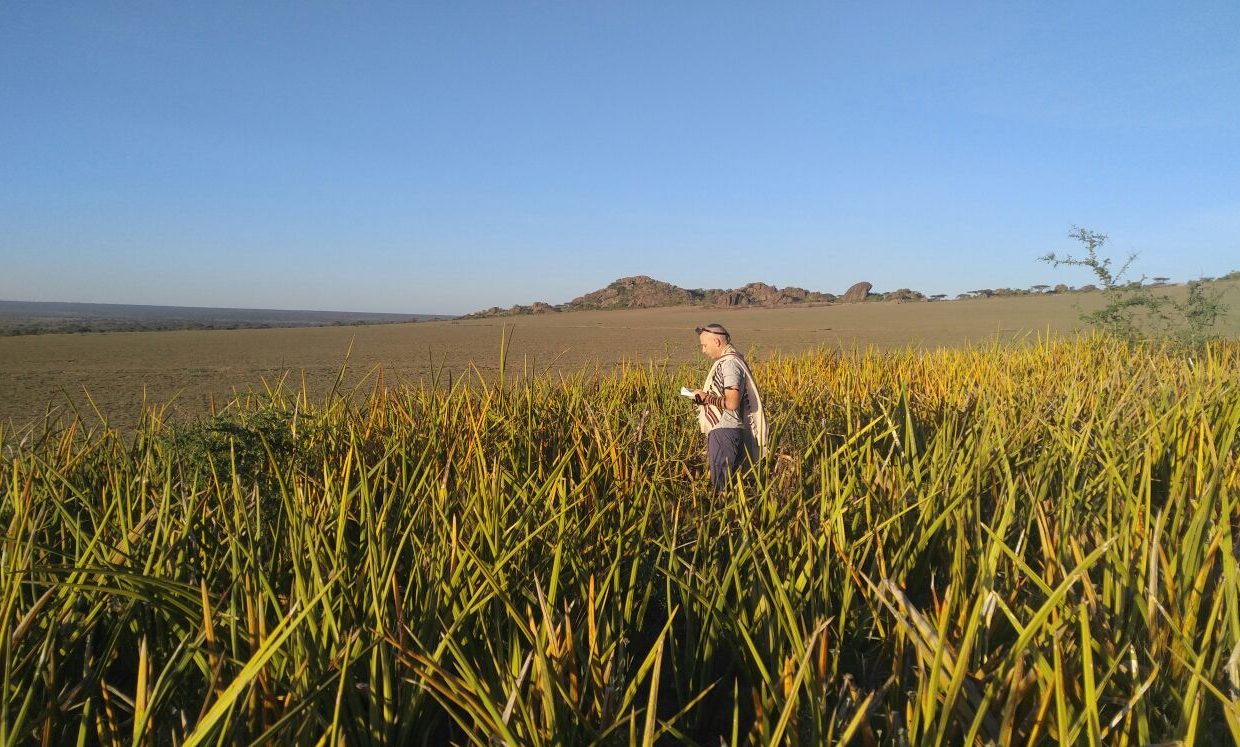
*By Hanouch Daum
It was not only the case of ‘visiting a country’ but ‘revisiting an idea’
Freelance Israeli journalist, a contributor to the national daily newspaper ‘Yediot Achronot’, a standup comic, author of six books, and local TV personality, Hanouch Daum visited Uganda in December 2017 during the Jewish festivity of Hanukah.
Why Uganda?
So desperate was the plight of Jews at the turn of the 20th century with pogroms in Europe, that the father of modern-day Zionism, Theodor Herzl, was considering a ‘sacrilegious’ proposal of Uganda as a future state for Jews rather than them returning to their ancestral biblical homeland in Palestine which at the time fell under the Ottoman Empire.
Saving Jewish lives was paramount to Herzl’s thinking. Almost 115 years after this ‘Uganda Proposal’, Daum visited Uganda to explore the country that could theoretically have been his home!
Back in Israel, this is his report.
Before I thought about what a different road it would have been for Israelis had they followed Herzl’s ‘road map’, I could not escape thinking during the long days traversing that landlocked country:
Most of the roads in Uganda are unpaved!
We traveled on bumpy gravel rural roads – a far cry from the highways and freeways of modern Israel – and saw children and women carrying water in jerrycans on their heads. I was struck how upright they walked. In the West, such posture you would only see amongst Olympic gymnasts. No running water in their homes, so as a matter of routine, they walk to draw water from the well. In Israel, my family would go crazy if suddenly there would be no hot water for a shower!
I gaze upon young children, splashing, shouting, and laughing while they take their daily bath in the river!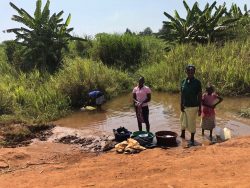
These youngsters – nurtured in nature – create their own amusement. Remove an Israeli child’s iPhone and they will threaten a hunger strike, but in Uganda, the children run with a stick and a tire, and they seem to be living in heaven.
How vast the contrasts between our two worlds!
On the other hand, what must not be forgotten is children’s vulnerability – how the lives of children precariously hang in the balance.
While infant mortality rate in Israel is 3.5 deaths/1,000 live births, I came across areas in Uganda where parents do not name their child in its first year for fear that the infant would not survive.
AIDS remains rife with about 1.4 million people infected (many of them children), and the average life expectancy is around sixty.
Israel life expectancy on the other hand, is ranked eighth overall with 82.5 years on average.
Despite the high mortality rates, I sensed little depression, and death is processed as an integral part of life. People are born and at some stage die – and they do not make a big drama out of it.
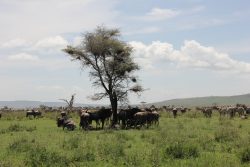
wildebeest crossing
Ugandan transport infrastructure is at the level of a ‘wildebeest crossing’. We stood in a traffic jam and no one honked. People here have all the time in the world. “Pola,” that’s their word for “patience”. In Hebrew its “savlanut” – an attribute few Israelis possess, and none in traffic. The joke in Israel:
Question: “What’s the shortest measured period of time in Israel?”
Answer: “The period between the traffic light turning green and the car behind hooting.”
When I asked in Uganda why this is so, they invariably answered: “This is Africa”.
I did reflect, that here was something we did lose out on by not establishing a state in Uganda – we could do with this “Pola”!
It is a land of few personal possessions. If they do not know what they are ‘missing’, there is little reason to be sad about it?
A westerner denied his cellphone for an hour would become insufferable – a cause for instant depression. And yet, Ugandans seem to make do in their mud hut huts without even mirrors. I suppose they’re okay with others telling them how they look!
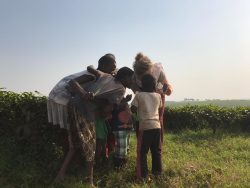
Showing Photos on a Cellphone
The youngsters were amazed when I showed them photos of my family on my cell phone. I’m not sure what more amazed them – my kid’s appearance or the cellphone technology!
And then you ask yourself – how do you measure happiness?
Here, parents don’t need photos of their kids as they see them growing up around them and playing all day in the fields. I saw how this young boy felt so proud when he handed his joyful mother some grasshoppers he caught for dinner that night.
Perhaps, this Ugandan child with grasshoppers in his hand is happier than that the indulged kid in the West clasping the handlebars of his electric bicycle!
Driving through the African countryside, sometimes my heart went out to the people I met on the way, while at other times, I envied them for the simplicity and quiet they enjoyed in their primitive villages.
I thought of Herzl, considering this land that had been suggested as a refuge for Jews. It was in 1903, following a proposal from the British Colonial Secretary Joseph Chamberlain. Anguishing over the Kishinev pogrom in imperial Russia where Jews were murdered, their women raped, and their homes destroyed, time was running out for European Jewry and Herzl began to push “the Uganda Plan”.
It was a case of physical survival before spiritual revival.
And so, for three years the Zionist Jews argued heatedly: Uganda – yes or no. State now – but in Africa, or wait for the State of Israel in their ancestral homeland.
Poor conflicted Herzl.
However, what would have happened if Herzl had won the day?
We Israelis live in a tiny country surrounded by enemies, while much of Africa and its vast open spaces is sparsely populated. What would have happened to Uganda if Jews had settled there?
For over two millennia since the Jewish exile, the Land of Israel had been neglected and in my view, no nation would have accomplished what we have in 70 years, since our independence in 1948.
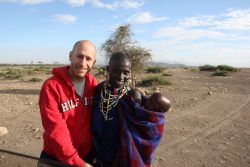
The Author with a Mother & Child
However, had Jews come to Uganda, what would have happened to us and to Ugandans?
How would we both as people evolved, and how would the country have developed?
Take the issue of medical health. Before the trip, I went to my dentist in Tel Aviv for root canal treatment because I was afraid to get stuck in Africa with excruciating pain. Throughout my travels, I saw only one dental clinic. On the other hand, the children there do not eat sweets, so there are almost no dental problems.
See what we lost! Israelis spend a fortune on dental hygiene.
And the stunning natural beauty each sight a page out of National Geographic….
Uganda borders Lake Victoria, which is larger than Israel. At nightfall, with a view of the hippos and crocodiles, I lit Hanukkah candles – it was the Jewish Festivity of Lights – and I must confess, I did not miss Israel’s famed Banias Falls.
What If?
Today there are 39 million residents in Uganda, 1.5 million of them in the capital, Kampala, which at best looks like our port city of Acre sixty years ago. I do think that had we come to Uganda, we would not have had to fight wars. The energy that Israelis invest today in protecting their borders, would have brought to Uganda prosperity and growth.
Incidentally, more than once, the first thing the locals mentioned when I said that I was from Israel was ‘Benjamin Netanyahu’. I know that Netanyahu is a loaded subject, but even his opponents will have to believe that despite his faults, the man, it seems, is beginning to be a brand in East Africa.
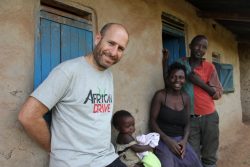
The Author with a hospitable Ugandan family
The Ugandans are hospitable. People wave when you pass; easily engage in conversation, and more than once, when our jeep convoy stopped for refreshment, local residents came out and invited us into their simple but warm dwellings.
Observing the women and children sitting in their yards – one doing laundry, another combing the child, the merchant popping in to sell milk and chat – I felt this was like a shtetl; those small Jewish villages in Eastern Europe that so molded our communal persona.
In general – whether in the countryside or cities – almost every sight appeared like pages out of National Geographic. Where else would one see a woman nursing a baby on a speeding motorcycle or the motorcyclist clutching a live turkey, while he navigates his way through city traffic on the way to the market!
Motorcycles are like taxis, and sometimes there are four or five people on one motorcycle with no one wearing a helmet! The women, by the way, sit on the side of the seat and not with their legs apart, for reasons of modesty. This is reminiscent of the Jewish custom that forbade a woman to ride a stallion – a practice that no longer exists today.
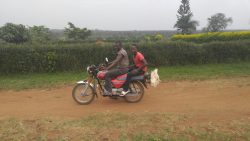
A local Taxi in Uganda
Comparing to Israel in respect of the law, there are areas that the Ugandans have not yet progressed. Homosexuality, for example, is prohibited by law. This, of course, does not mean that there are no gays there, but you can be sent to prison for this offence, so this lifestyle is conducted somewhat underground, although I did on occasion see same-sex couples walking holding hands. Tel Aviv, on the other hand, is one of the top gay capitals of the world, where people from all over the world can come and be open about their sexuality.
When it comes to trade and commerce, Uganda has a long road ahead. And yet, there is something charming and primal about the farmers coming to the market with the produce from their fields, selling it independently and sometimes bartering. Sure, they could learn from Israelis, but while I was there observing, I felt it was me that had much to learn!
Back in Israel, the visual image that most appears to me of what Uganda would have lost with Israelis there would be the loss of the absolute darkness of the night. With no electricity, and as the typical African day in rural Uganda draws to a close at sunset, and darkness descends, the villages are silent.
There is some elusive beauty and excitement in this way of life, which is in sync with the rising and the setting of the sun, and which is foreign to Israelis and their frenetic lifestyles.
Would the people from the ‘Land of Milk and Honey’ and the people of the ‘Land of the Grasshoppers’ have gotten along?
Would we have become more like them or them more like us, or would we together have emerged into something quite different?
Intuitively, one wizened old man in a village said with a broad smile:
“You have a clock, we have time”
*Translated & Edited by David E. Kaplan.