South African in Israel explores the complex interactions between man and water.
With many regions in South Africa experiencing severe drought, it is intellectually ‘quenching’ to come across such an illuminating perspective on the issue of water, particularly by someone who has such an enriching connection to South Africa.
Nina Selbts of Savvyon – a city in Israel established by South Africans in the 1950s – is the daughter of the late esteemed Judge Joseph Herbstein who was born in Graaff-Reinet, South Africa in 1897. Practicing at the Cape bar, Herbstein became a King’s Counsel in 1939 and was the first Jew raised to the bench in the Cape Division in1946. As senior judge, he acted for a time as judge president of the Division. He retired in 1963 and settled in Israel. His legal writings on South African civil procedure were the standard source of reference for lawyers and students.
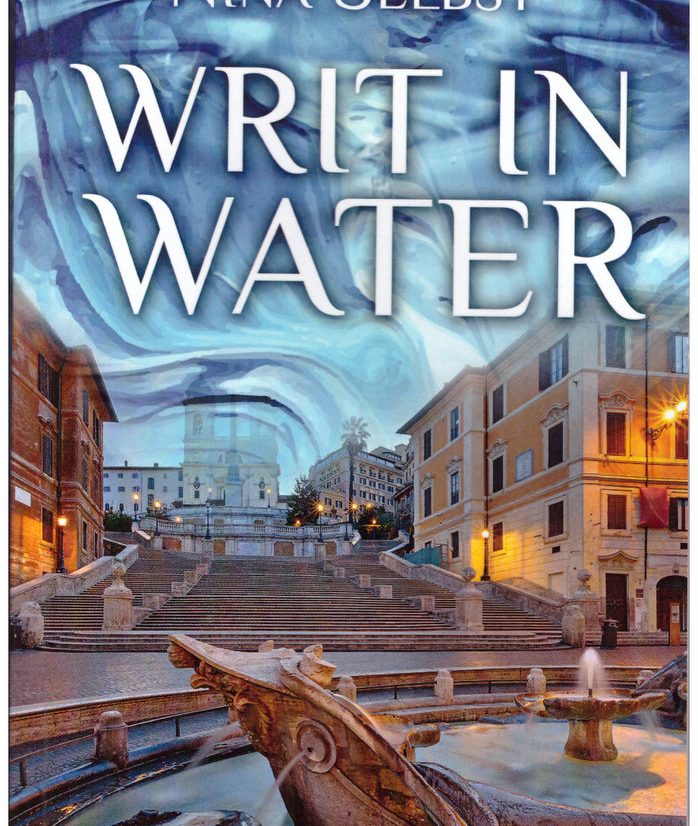
His daughter now too has put pen to paper with her nearly 500-page journey of discovery: “Writ In Water”, available through Amazon.
“Water leaves its indelible stamp everywhere. No poetry, no human life, indeed no life at all, would exist on earth were it not for the presence of water,” philosophically muses Nina in her recently 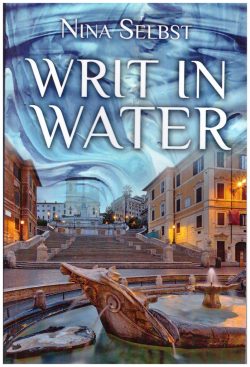 published ‘WRIT IN WATER’. As to the choice of her title, the author takes the reader back to the poet, John Keats succumbing from consumption at his lodgings in Rome overlooking the La Barcaccia Fountain. From his window, the ailing 24-year-old muse had a view of the battered bronze boat in the square below, sprouting water from its multifarious holes and appearing to sink beneath the sea. “Perhaps it was this sight that inspired the epitaph Keats wrote for himself: “My life is writ in water.”
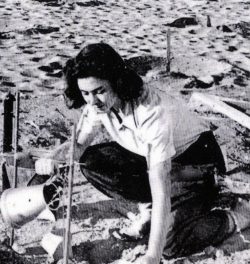
Nina Selbts planting on kibbutz Shoval in the late 1940s
Tapping into Truths
Far more intimate than Keats was this former South African’s relationship with water. Nina joined the Water Commission – the government department responsible for the development and management of Israel’s water resources – at the beginning of the 1960s as a junior economist. She retired three decades later as economic advisor to the Water Commissioner and head of the Commission’s Economic Bureau.
During those formative years of the young state, the author worked alongside that breed of pioneering engineers and hydrologists, agronomists and farmers, scientists and policy makers that transformed the landscape of Israel fulfilling the biblical prophecy of “making the desert bloom.” On retirement, still fascinated by water, Nina devoted her time to exploring water’s complex interactions with the human species and her book is a product of her global journey of discovery. “I have wandered far and wide on a meandering journey, like that of water itself. I have explored the interface between humankind and this deceptively bland, colourless, tasteless and odorless substance. I have delved into creation myths; looked at the emergence of civilizations and their decay; pondered the place of water in the human psyche as expressed in art and poetry and folklore; considered its role as a factor of production, a source of energy, a conduit of transportation and a consumer good. In passing, my attention has been caught by wishing wells and water closets, changing concepts of physical and spiritual cleanliness, and a miscellany of comic and curious trivia.”
The book has no pretentions of being an academic work and contributes, in the author’s words of “restoring a sense of wonder at this elixir of life in the number of city dwellers, who give it scant attention as long as it flows from their taps.”
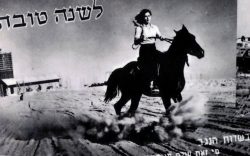
A New Year card showing the author, Nina Selbts riding horseback on kibbutz Shoval in the Negev in the late 1940s
Geneses
Crisscrossing backwards and forwards over the millennia, Nina traverses the globe “entering the realm of the spirit and the spirits, and the everyday world of production and consumption.”
Not surprisingly the book opens with “The Mediterranean Basin”. “Before the world began there was only water. The Primeval Waters filled the infinite void to the exclusion of all else. Only when the Waters were condensed and gathered together, could Creation proceed. So it seemed to the Babylonians, Egyptians, Israelites, and Greeks alike, as they struggled to structure a confusing and frightening universe, make sense of the human condition, and probe the significance of life itself. From the watery chaos that was their common point of departure, the accounts of geneses given by these different peoples, diverged as each culture drew on its own particular experience to interpret the vast world beyond its ken.” Closer to home, is Nina’s chapter on Jerusalem – a ‘watertight’ response to the assault of Israel’s enemies today undermining the Jewish connection to its territorial roots. “Once David decided to build the capital of his kingdom in the Judean Hills he had no alternative but Jerusalem, even though it had been already settled by the Jebusites. No other site in the entire region gave access to sufficient water to maintain even a token urban settlement. It was the Gihon spring that had led the Jebusites to settle the site and now led David to fight to possess it.”
How history is shaped by the courses and carriage of water. Some 300 years following David’s conquest, Jerusalem, then ruled by King Hezekiah, was again threatened by siege – this time by the Assyrian king, Sennacherib. To defend, Hezekiah sealed the springs outside Jerusalem’s walls to deprive his enemy of water and had a tunnel dug to divert the waters of the Gihon into a pool inside the city walls”:
And when Hezekiah saw that Sennacherib was come, and
That he was purposed to fight against Jerusalem,
He took counsel with his princes and his mighty men
To stop the waters of the fountains….
Why should the kings of Assyria come and find much water?
Chronicles 32:2-4
Using primitive tools, Nina reveals how the tunnel proved a marvel of engineering. “As the crow flies, it was three hundred and twenty meters long, but it twisted and turned through five hundred and thirty-three meters.” With two crews working from opposite ends, “the tunnel managed to meet with hardly an error of alignment.” This achievement which was recorded in an inscription, was removed from the tunnel by the Istanbul Museum of the Ancient Orient in the 19th century, and can still be seen there today.
A lengthy 462-page read with many illustrations, Nina’s trail meanders like a river, settling along the route in metaphorical ‘lakes’ and ‘reservoirs’ of intellectualism, poetry, science, history, geography, mythology and archeology, finally settling – to quote the Bard of Avon – in a “sea of troubles”. While “the dawn of the modern, scientific age” has opened the way “for great strides forward in agricultural production, flood control, power generation, sanitation, and general living standards,” it has come with a price.
Recalling Hamlet’s counsel to Horatio that “There are more things in heaven and earth, than are dreamt of in your philosophy,’ Nina laments that ‘progress’ has ‘overreached itself by failing to give cognizance to the possibility of things not dreamed of in any philosophy.” It has “impoverished the environment by damage to eco-systems and reduction of in the variety of plant and animal life. It has emptied aquifers, drawing down the accumulated reserves of millennia. And free-flowing water, with its intangible capacity to inspire awe to refresh the soul and to restore the spirit, has virtually disappeared, to be replaced by water in harness, by bureaucratically managed rivers, lakes and even waterfalls.”
Facing exploding population growth, “the greatest reverence for water cannot preserve its purity,” bemoans Nina, citing the sacred River Ganges, worshiped by India’s Hindus. “Whether the source is factory waste or untreated human excrement, when rivers and lakes are overloaded with extraneous substances and their self-restoring recuperative capacity is stretched beyond its limits, pollution and eutrophication are the inevitable consequence.”
No Return to Eden
“Even a substance as ubiquitous as water is becoming scarce relative to needs,” warns Nina. “The day is approaching when no-one, anywhere on earth, will enjoy the luxury of fresh, wholesale water as the free gift of nature.” She cautions that there “is no road back to some primeval Eden, to some ancient state of innocence; no way of regurgitating the apple and returning responsibility to the lap of the Gods. Future generations will enjoy the wholesale water for which we all thirst only if we act to create it anew. Advances in technology will not suffice to this end. A radical change of attitude towards the planet and its resources is what is called for – a new ethic.” We owe a duty of care to the waters of the world. “it matters not whether we believe that this is a moral imperative or a matter of self-interest. If the waters lose their power to succour the spirit and then the body, humanity will surely diminish and then expire with the dying waters.”
I am reminded of the saying from Native American folklore: “We do not inherit the land from our ancestors; we borrow it from our children.”
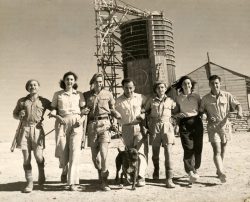
Nina Selbts on Kibbutz Shoval in 1947.(i-r). Jackie Gross, Yehudit Verbranchik, Zvi Zipper (Rhodesia), Meir Sherman, Gideon Rosenberg (who was killed in the fighting to keep the road to Jerusalem open in 194) and Nina Herbstein (Selbst). Says Nina, “The chaverim (friends) in this photo are all Southern African, except for Satan, the boxer dog who helped Zvi and Gideon guard the pipeline.”