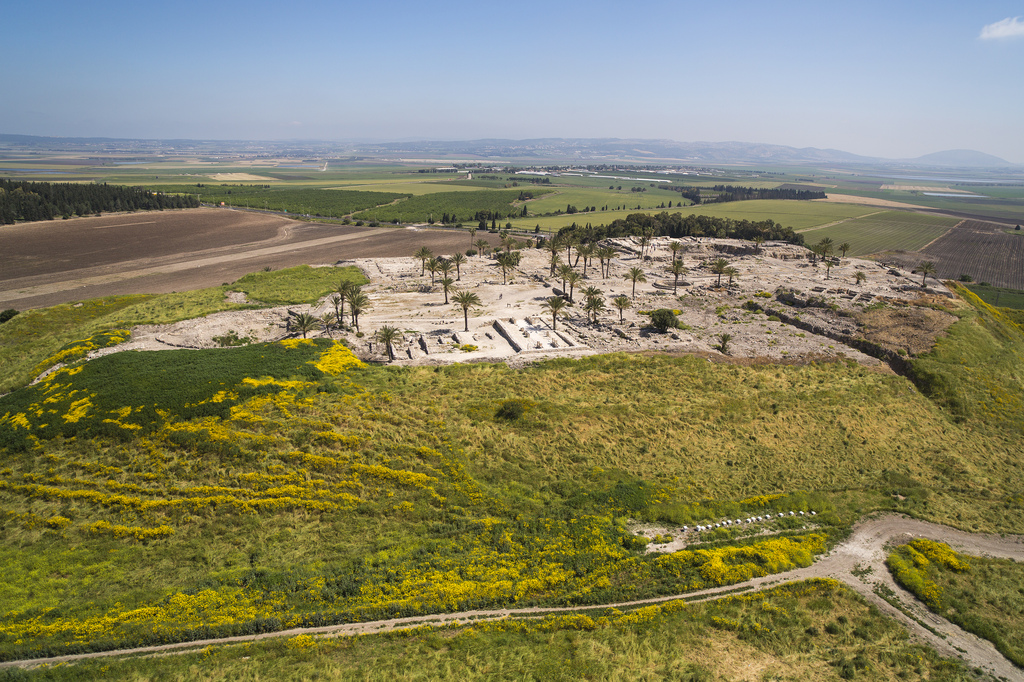
Welcome back to our virtual tour of Israel. Today we will travel down the eastern side of the Carmel Mountain and stop at a place called Har Megiddo. Har Megiddo is a tel, which is made up of an ancient city built upon another city, or multiple cities. The word “Har” in Hebrew means mountain. In the biblical context Har Megiddo is known as the future site of Armageddon; the prophesied location of a gathering of armies for the “Battle of the End of Days”. The geographic location of Har Megiddo places it as one of the most critical land crossroads in history. Israel was the land bridge between Egypt and Mesopotamia (corresponding to today’s Iraq, mostly, but also parts of modern-day Iran, Syria, and Turkey). Each and every trader traveling on the trade route of the Via Maris had to pass by Megiddo.
All kings fought over this city. Megiddo was conquered and rebuilt 25 times in the course of history. Each time the city was rebuilt, the rubble from the previous conquest was used as the foundation for the new city. So beginning 6,000 years ago, Megiddo has acquired 25 layers of a city built on a city, built on a city, etc. There were water springs and fertile land as far as the eye could see. Every ruler wanted control of this area. Whoever controlled the route-controlled the region.
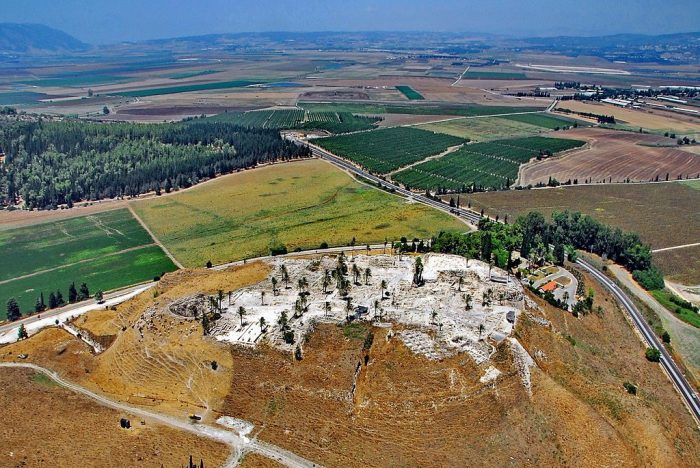
Ariel view of Megiddo. Photo Credit: Watch Jerusalem
One of the most infamous battles for Megiddo happened in 1482 BCE. The Canaanites were in rebellion to Egyptian rule so Pharaoh Thutmose III went on a campaign against them. The Canaanite ruler of Kadesh and the king of Megiddo were mustering troops in the Jezreel Valley somewhere beside Megiddo. There were three routes into Megiddo for Thutmose III. He would be coming from the coast on the Via Maris. The main route, called Wadi Irona, and two alternate less traveled routes were his options. Thutmose III assumed that the Canaanites would not think he would come thru the main route because it would be suicide for the Egyptian army. The pass is so narrow that once they got to the end, they would be sitting ducks for an ambush. This pass is still the main route from the coast to the east. If you drive through this narrow pass today, you can get the idea of how it would not make sense for Pharaoh to take his army this way. It would have made them extremely vulnerable from the cliffs above. But he gambled that the heaviest amount of troops would be at the two alternative routes. Against the advice of his advisers, he went straight up to Megiddo through Wadi Irona, or Wadi Ara as it is known today. The gamble paid off, the Egyptian army came right thru the main road and caught the Canaanites by surprise.
It was May and the wheat was ready for harvest. The Egyptians had plenty of food and the Canaanites were behind closed gates. Even the people trying to get back into the city, had to be hoisted up by ropes in order to get back in because they wouldn’t risk opening the gates for them. The Egyptians turned aside from the chase to seize booty for themselves, thus, losing the chance to end the war in one day. It took Thutmose III seven more months of siege before Megiddo finally surrendered. Megiddo ultimately became such a strong center for Egyptian rule that when the Israelites conquered and settled the land almost 300 years later, they were unable to take Megiddo. The first time Megiddo fell into Jewish hands was during the time of David and Solomon.
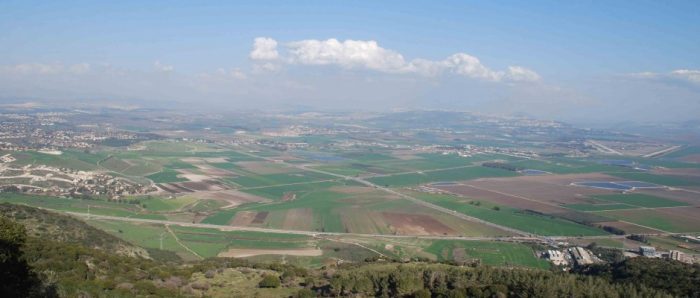
Photo Credit: Eschatology Today
Now let’s take a short hike to the top of Har Megiddo… As we walk along the way we get about halfway to the top and see a set of steps descending from the side of the mountain. These steps date back to the time of the Israelite period. When we get to the top of the mountain we will see just where those steps led to. It’s actually very exciting ☺
Reaching the top we come to a massive gated entryway. This is a typical Canaanite Four Chambered Gate and could possibly be the same gate that Thutmose III went through when he conquered Megiddo. The base is made of basalt and there are olive wood beams placed inside the construction of the gate whose function was to absorb the weight during earthquakes. That could be why part of it is still standing today. As we pass through the remains of the gated entry to Megiddo we can see two rooms (or chambers) on each side. Walking through an ancient gate and entering into 6,000 years of history is pretty awe-inspiring.
Now we begin our journey on the top of Megiddo. The first thing we will see is what looks like three fairly large rooms, one next to the other. One of the rooms is filled in completely with rocks. As we make our way up for a closer look, we find something fantastic…actually thrilling. It is three chambers of what was once a six-chambered gate. What is the thrill? It dates to the Israelite period and is even mentioned in the bible! This gate is where those steps led to.
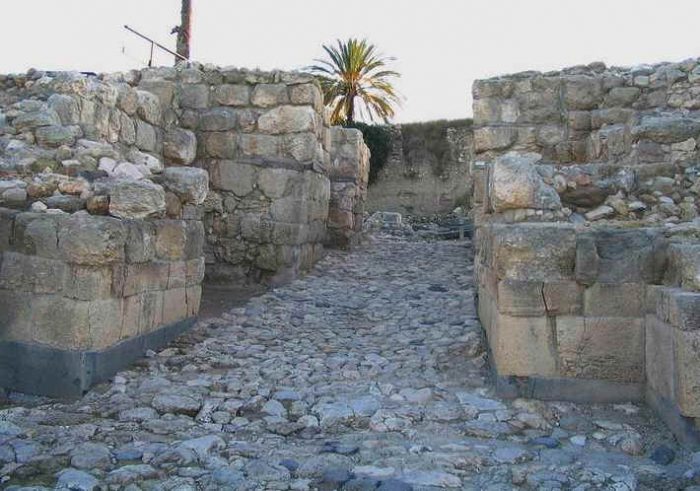
Canaanite Four Chambered Gate. Photo Credit: Biblical Israel Tours
“Here is the account of the forced labor King Solomon conscripted to build the Lord’s temple, his own palace, the terraces, the wall of Jerusalem, and Hazor, Megiddo and Gezer.” I Kings 9:15
Here we read that Solomon is credited for building three fortifying walls other than Jerusalem: Hazor, Megiddo and Gezer. We are standing in a place that is “x” marks the spot. We are standing at the location of the Solomonic wall of Megiddo. We are standing on 3,000 years of biblical history. This is where the bible meets archaeology. The most exciting thing is that all three walls have been found by archaeologists in the last century! Some archaeologists fight over the dating of the walls, mostly in order to dispel the importance of the kingdom of David and Solomon, but all agree they are Israelite.
What I can tell you is this: If you stand at these gates and open your bible and read this passage of scripture you will have been honored with seeing the Bible come alive as it might never have before. Just a small sentence in scripture becomes big as life when you stand on “x” marks the spot.
It is a privilege to lead you on this journey through time. We have only scratched the surface (literally) of Har Megiddo. There is much more to come in learning the archaeological history, but also what the prophetic future holds for this mountain of cities.
Until next time, shalom from Israel!

Tel Megiddo. Photo Credit: See the Holy Land