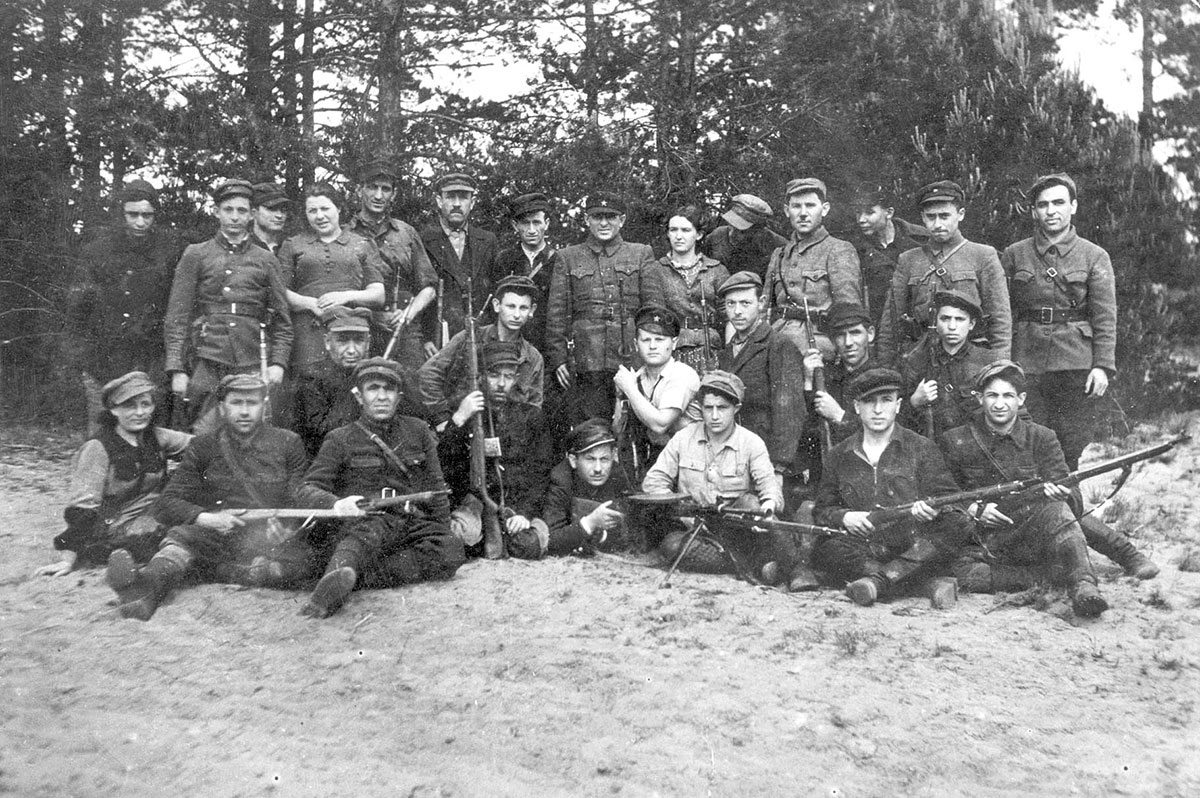
Lest you think that all the Jewish people just walked to their death in WWII, we want to remind you about the Jewish fighters, called Partisan Fighters, that fled to the forests, remote towns or hid anywhere they could and organized themselves to fight back and save as many fellow Jews as possible. The picture shown above is of a group of partisans from different brigades guarding the airstrip in the Naliboki forest, July 1944.
It is estimated that there were between 20,000 to 30,000 Jewish Partisan fighters in WWII. They used guerrilla warfare and sabotage against the Nazi occupation, and in Lithuania alone, they killed approximately 3,000 German soldiers.They sometimes had contacts within the ghettos, camps, Judenrats or Jewish councils in the ghettos, and with other resistance groups, with whom they shared military intelligence.
A group of partisan fighters that gained more visibility in popular culture were the Bielski partisan fighters, about whom the 2008 movie, Defiance, was based loosely on. Under their protection, 1,236 Jews survived the war, making it one of many remarkable rescue missions in the Holocaust. The group spent more than two years living in the forests of Poland, what is now western Belarus.
The conditions they lived in were extremely difficult, starvation was a frequent concern and they had to put aside any dietary laws they followed as Jews in order to survive. Stealing from the Germans was a two-fold success. Take from the enemy and keep the fighters and their families and refugees alive. They also raided nearby villages for food and although there were those that willingly helped them, if some did not, violence sometimes ensued. But the primary mission was always to save a life.
As you can probably imagine, cooking was at its simplest form, and consisted of whatever they were able to beg, borrow or steal. We can imagine that this simple stew might have been a staple in their camp and could have taken many forms. The recipe we will share is a traditional cholent or beef stew that can also be made vegetarian. Make sure you have a slow cooker or a large cast iron pot. This will have to cook overnight so plan ahead!
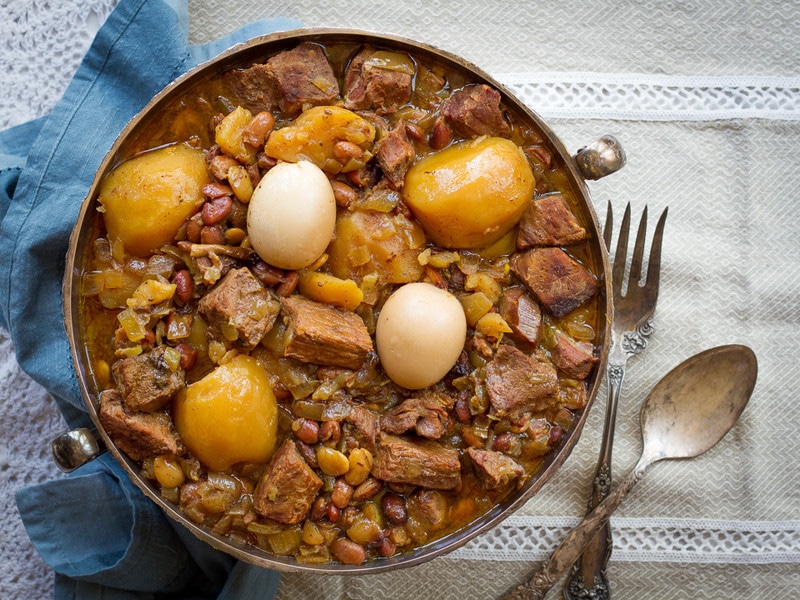
A traditional Cholent stew, picture by Louise Mellor for toriavery.com
1- Note: The beans in this recipe will soften without any pre-soaking due to the long slow cooking process, however they will be easier to digest with a simple quick soak prior to cooking. To do this, place the beans into the bottom of a large pot and cover with water. The beans will expand to over double their size, so make sure you cover by several inches of water to allow for expansion. Bring the beans to a boil for 5 minutes, then remove from heat. Let them soak in the cooking water for 1 hour, then drain and rinse well before proceeding with the recipe. Also note that it is not recommended to slow-cook kidney beans.
2- In a large slow cooker (the larger the better!), place the potatoes in a single layer on the bottom of the cooking vessel.
3- Sprinkle the onions over the potatoes.
4- Place the beef in a single layer on top of the onions and potatoes.
5- Rinse the beans clean, checking for any stones or impurities. If using barley or kasha, do the same with the grains. Sprinkle the beans (raw or pre-soaked) and optional grains over the top of the meat. Place the three whole garlic cloves into the meat, evenly spaced. Sprinkle the whole mixture with the black pepper.
6- If using eggs, rinse them well and then tuck them into the meat. In a 4-cup container, whisk together the low sodium chicken broth, kosher salt, paprika, turmeric, cumin and cayenne.
7-Pour the liquid over the cholent. Add additional water until all of the beans and pieces of meat are covered. For us, it’s usually another 1-2 cups of water in our slow cooker– it will vary; I usually add a bit more liquid if using grains, because they will soak it up.
8-Cover the slow cooker. Cook on low heat for 16 hours. Check occasionally as it’s cooking; add additional water and stir a bit if it’s looking too dry. Most cookers will auto-switch to warm when the cooking is complete. If yours doesn’t, set it to warm until ready to serve.
That’s it! Feel free to do it with only beans and add carrots or more potatoes in place of the meat. It may cook a bit faster so be ready to turn your cooker to warm only so it doesn’t get overcooked. We hope you enjoy this tasty recipe and take the opportunity to remember the partisan fighters and bravery they showed. As always, if you try this please let us know!
See the full post:https://toriavey.com/toris-kitchen/cholent/#CVz087bIQqwyYtuV.99