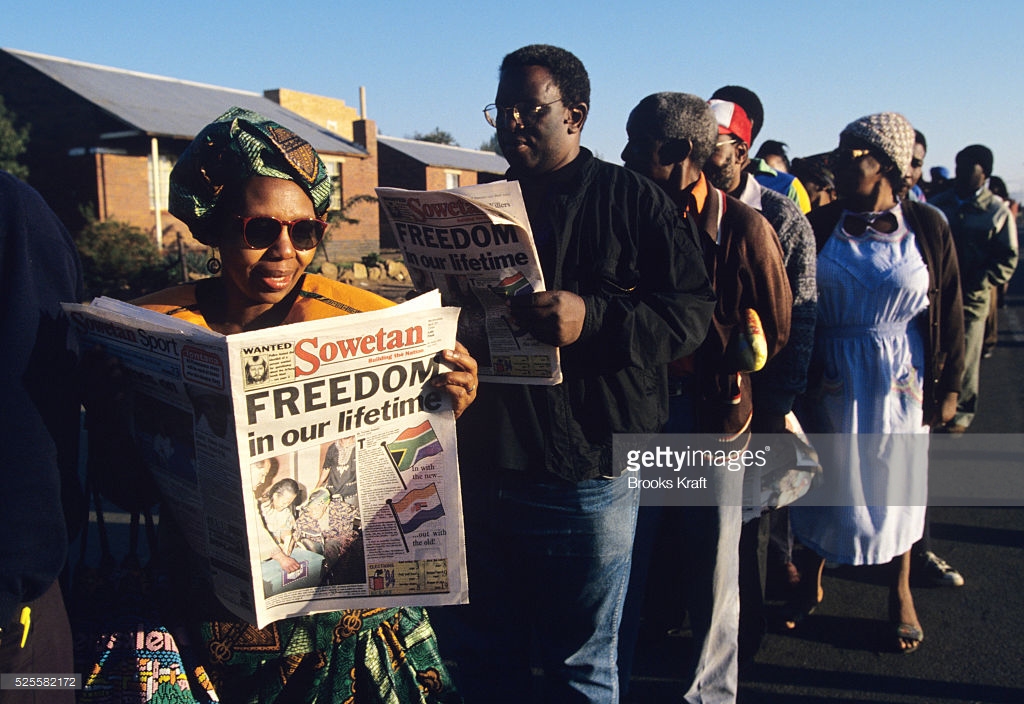
Millions of South Africans voted in the nation’s first free and democratic general election. Photo: getty images
April is a very significant month in the South African calendar, as it is marked annually as “Freedom Month,” where freedom, democracy and unity are celebrated throughout the country. The month is highlighted on April 27th, “Freedom Day,” marking the day in 1994 when South Africa’s first free and fair democratic elections were held with the historic participation of all South African citizens. This saw an end to apartheid politics and policy and the birth of freedom and constitutional democracy. Considering how objectively, and tragically, recent these events were, there are many in South Africa today who can still speak to the pain and devastation of living under the apartheid regime. There is an acute sensitivity among South Africans to victims of the same or similar forms of repression, combined with an admirable sense of duty to combat such injustices.
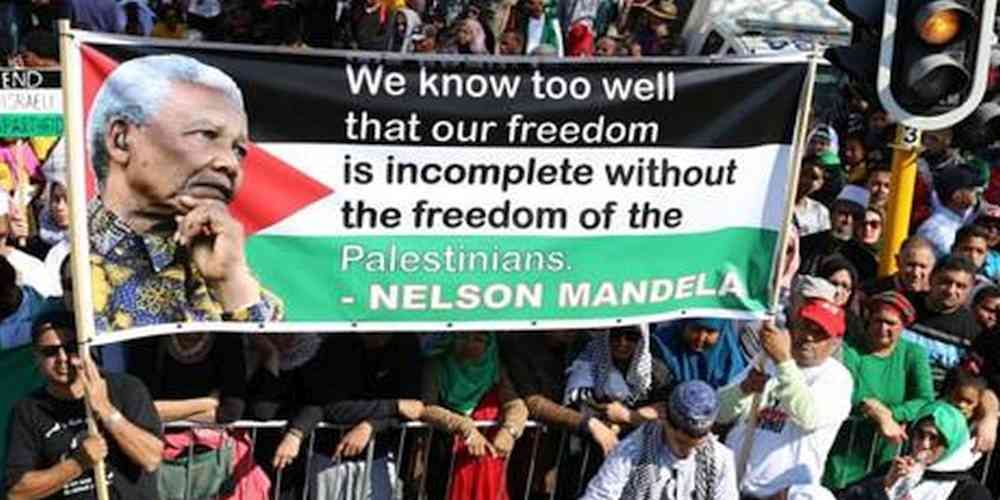
South Africans taking to the streets to protest against Israel.(pic: mondoweiss.net)
Among the many issues dominating the South African political and social arena is the Israeli-Palestinian conflict. South Africans over the years have spoken of feelings of common bonds and cause with the Palestinians, often accusing Israel of their oppression. Sadly, this narrative has been emboldened by the hate-filled rhetoric of movements like Boycott, Divestment and Sanctions (BDS), South Africa, who have capitalized on the most profound sensitivities of South Africans, and manipulated reality to demonize Israel and weaponize a population against the state.
The fact is that the Palestinian population have been the victims of unfair, unbalanced and cruel oppression. Innocent Palestinians have their lives threatened, their rights abused and their futures crushed constantly, but it is not Israel perpetuating these crimes. From the pre-state Arab population of the British Mandate of Palestine, to modern-day Palestinians, the population has been systematically used as pawns in the Middle Ease region’s anti-Israel, anti-Jewish ideology. Arab countries in the region, and the ruling Palestinian parties, the Palestinian Authority (PA) in the West Bank, and Hamas (a designated terror group) in Gaza oversee more Palestinian suffering than any Israeli government.
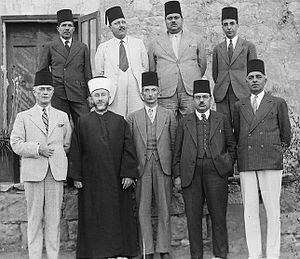
Members of the Arab Higher Committee, 1936, who ordered their fellow Arabs to leave their homes. (wikipedia)
The day following Israel’s declaration of Independence, it was immediately attacked by the armies of Egypt, Jordan, Syria and Iraq. Today, this occasion is marked as “Nakba” (the catastrophe) by Palestinians and Arabs worldwide and is intended to draw attention to their flight and subsequent loss of land as an entirely Israeli crime. The truth is that many Palestinians were ordered to vacate their properties prior to the declaration, in order to make way for the invading armies. They did so en masse, and cheered the invading forces as they came to destroy the newly formed Jewish state. The Economist noted on October 2, 1948, for example, that “of the 62,000 Arabs who formerly lived in Haifa not more than 5,000 or 6,000 remained… There is but little doubt that the most potent of the factors were the announcements made over the air by the Higher Arab Executive, urging the Arabs to quit….It was clearly intimated that those Arabs who remained in Haifa and accepted Jewish protection would be regarded as renegades.” The Arab National Committee in Jerusalem similarly ordered civilians to leave their homes, announcing that “any opposition to this order… is an obstacle to the holy war and will hamper the operations of the fighters in these districts.”
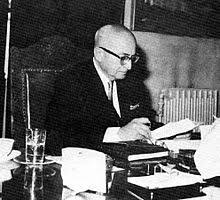
Khalid al Azm (wikipedia)
The Secretary of the Arab League Office in London, Edward Atiyah, wrote in his book, The Arabs, that “this wholesale exodus was due partly to the belief of the Arabs, encouraged by the boastings of an unrealistic Arabic press and the irresponsible utterances of some of the Arab leaders that it could be only a matter of weeks before the Jews were defeated by the armies of the Arab States and the Palestinian Arabs enabled to reenter and retake possession of their country.” When Israel wasn’t defeated and its Jewish inhabitants weren’t slaughtered to the last, this too somehow managed, to this day, to become Israel’s fault. In fact, in his memoires, Khalid al Azm, a Syrian national leader and five-time interim Prime Minister, himself admitted the Arab role, writing that, “since 1948 we have been demanding the return of the refugees to their homes. But we ourselves are the ones who encouraged them to leave. Only a few months separated our call to them to leave and our appeal to the United Nations to resolve on their return.”
Moving on, it is equally critical to focus on the treatment of Palestinians across the Arab world. While utterly ignored by the world’s media, and despite sharing similar cultural, linguistic and historic backgrounds with the countries they reside in, Palestinians in Arab countries endure systematic repression, violence and abuse. For example, ever since Jordan’s 1988 judicial and administrative disengagement from the West Bank, many Palestinians in Jordan no longer have citizenship rights. This means that obtaining health care, finding work, owning property, travelling and sending children to school is exceedingly difficult. A 2010 Human Rights Watch analysis on this issue also found this process to be utterly arbitrary in its execution, with no real regard as to who is affected or why.
Also largely ignored by world, is that nearly 4,000 Palestinians have been killed under the most inhumane circumstances in Syria thus far as a result of the civil war. With that said, Jordan began denying entry permits to Palestinians living in Syria as of 2012, officially declaring a non-admittance policy in 2013. The head of Jordan’s Royal Hashemite Court told Human Rights Watch in May 2013 that the influx of Palestinians would alter Jordan’s demographic balance and potentially lead to instability. Those that have managed to find residence in Jordan have no proper documentation and are therefore routinely made victims of exploitation, arrest and deportation. Egypt, Lebanon and Tunisia have all taken similarly arbitrary measures to bar Palestinians from Syria from entering their territories, on top of their own pre-existing and repressive policies against Palestinians. Where is the international criticism there?

Hamas Flag-Gaza
Fatah Flag-West Bank
There is no doubt though, that the greatest abuser of Palestinian rights is the Palestinian leadership itself. In the West Bank, children are taught to hate and seek martyrdom through terror at PA-run schools. The families of those who carry out attacks against Israeli civilians are rewarded financially and glorified publicly. In Gaza, civilians are routinely used as human shields. Hamas militants use civilian structures and internationally recognized safe havens such as hospitals to base its operations and stage its attacks. They conceal themselves among civilians, firing rockets from civilian homes and schools, with the aim of causing indiscriminate damage to Israeli civilians. Moreover, there is no shortage of documentation relating to the abject fear and repression locals living under the PA and Hamas endure. Even the suspicion of collaboration with Israel can lead to violent imprisonment, torture and death. Despite being one of the largest recipients of aid in the world per capita, Palestinians continue to be among the most deprived populations. Money is routinely diverted to fund terror activities and line the pockets of Palestinian leaders. Critical infrastructure and materials are used or repurposed to commit acts of terror, such as the substantial quantities of cement intended for the reconstruction of Gaza that went instead to the building of terror tunnels into Israeli territory.
Despite the aforementioned facts, Israel is still singled out as the sole violator of Palestinians rights. While this piece scarcely even begins to touch on the extent to which, both historically and today, this has never been the case, it is hoped that it will embolden those who are committed to identifying and combating rights abuses in the world to do so with as full and complete a perspective possible.