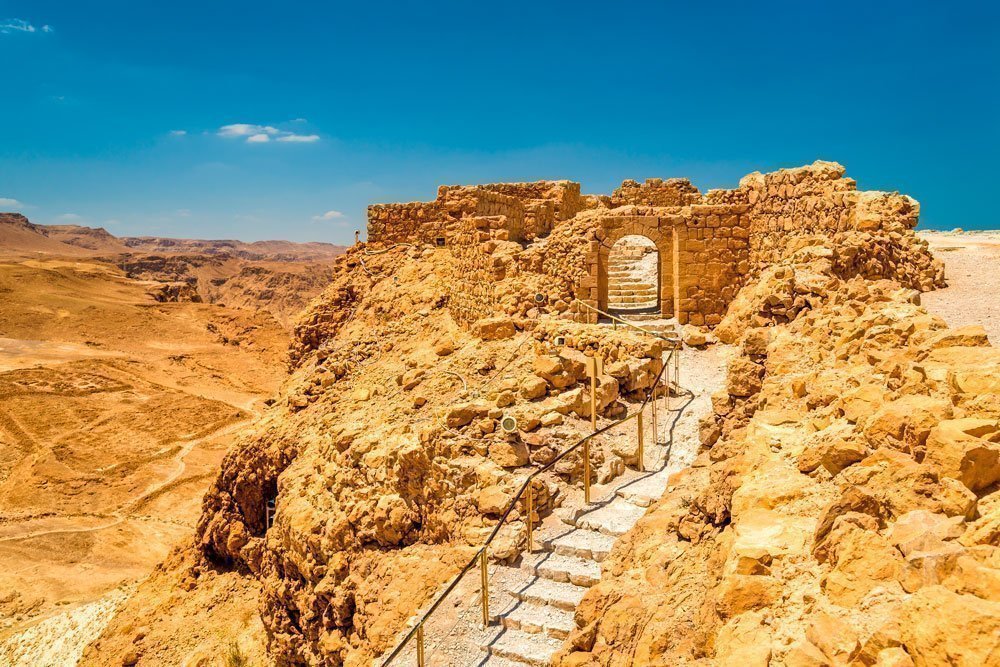
Welcome back to our virtual tour of Israel where we are picking up where we left off last week from Masada. We talked about the story of this unique place and its tragic ending. If you were not with us last time, please go back and read Part 1 so you will understand Masada in its full context. Today, as we leave the three-tiered Northern Palace, we will make our way to the Bathhouse. But first, we have an amazing view that we should not miss. From our vantage point, we can see a great deal of the top of Masada. It is a huge flat rock about 600 meters long and 300 meters wide. We are on the most southern point of Masada and looking north we can see the Bathhouse and next to it and just beyond it we can see row after row of long narrow rooms.

View from the top of the stronghold of Masada. Photo Credit: Masada Tours
According to Josephus, there were stashes of all sorts of weapons and a large quantity of grain, wine, oil, and dates. Vessels were found under the rubble amidst the ash from the fire the zealots started. The vessels were all broken; probably by the zealots who didn’t want the Roman garrison to get a hold of them. Each storeroom had its own kind of vessels for storing wine or oil, etc. The jars were probably from the time of Herod, but were used by the zealots. Hebrew letters were written on the jars to mark what the contents were. Some of them contained the tithe that was written in the commandments to give. The zealots were not just political rebels, but they apparently kept to strict Jewish Law as well.
A huge storage jar was found completely intact during the course of the dig. Some of the storerooms appeared to be untouched and not burned out. The explanation could be that the zealots didn’t burn all of the food, but wanted to show the Romans that they didn’t kill themselves from starvation; they just didn’t want to leave them ALL of their food.
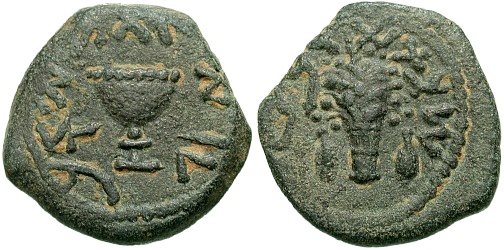
Coins were also found strewn all about the floor that dated back to 67-68 CE and was inscribed “For the Freedom of Zion”. There were no weapons found in these storehouses, but there were others found in other parts of Masada. It stands to reason that they were not in the storehouse, as they were probably all being used.
So now, we will go down to the Bathhouse. Of all the leisure activities, bathing was surely the most important for the greatest number of Romans, since it was part of the daily regimen for men of all classes. We think of bathing as a very private activity conducted in the home, but bathing in Rome was a communal activity, conducted for the most part in public facilities that in some ways resembled modern spas or health clubs, although they were far less expensive. Bathing had a fairly regular ritual, and bathhouses were built to accommodate this. Upon entering the baths, individuals went first to the Dressing room (Apodyterium). Although the evidence is not clear about exactly what Romans wore when bathing, it seems probable that they did not exercise in the nude, as Greek males did. The large central courtyard was the exercise ground (Palaestra). After changing clothes and oiling their bodies, male bathers typically began their regimen with exercise, ranging from mild weight-lifting, wrestling, various types of ball playing, running, and swimming. After exercise, bathers would have the dirt and oil scraped from their bodies with a curved metal implement called a strigil. Then the bathing began; accompanied by a slave carrying their towels, oil flasks and strigils, bathers would progress at a leisurely pace through rooms of various temperature. They might start in the warm room (tepidarium), which had heated walls and floors but sometimes had no pool, and then proceed to the hot bath (caldarium), which was closest to the furnace. Roman engineers devised an ingenious system of heating the baths—the hypocaust. The floor was raised off the ground by pillars and spaces were left inside the walls so that hot air from the furnace could circulate through these open areas. After this, the bather might spend some time in the tepidarium again before finishing in the cold room (frigidarium) with a refreshing dip in the cold pool. Other rooms provided moist steam, dry heat like a sauna, and massage with perfumed oils. All in all, it was a perfect way to end the work day and socialize, or do a little business before going home to the wife and family. The Bathhouse on Masada is one of the best preserved in Israel. We can still see some of the original tile flooring and frescoes on the walls. The caldarium is one of the most impressive sites on Masada. It is a definite “must see.”
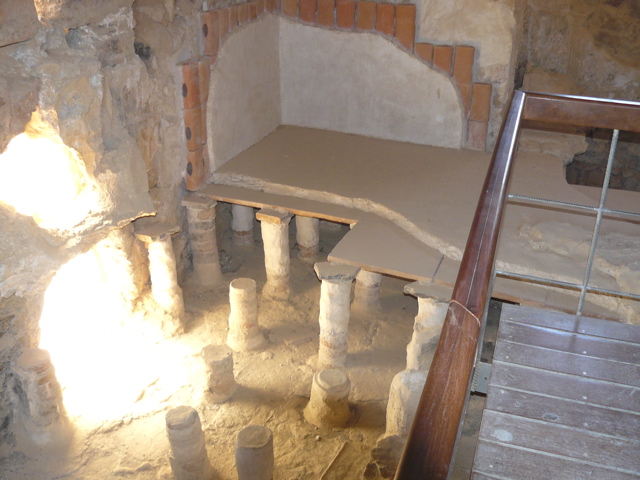
Roman bath house. Photo Credit: Wells
Once we leave the Bathhouse we can walk along the casemate wall that surrounds Masada. A casemate wall is a double wall with space in between. This type of wall was built along the entire circumference of Masada. The space between the walls was used for living, learning, storage and even libraries were housed in between the walls. It was a great use of space and much more secure than a single wall.
We can look over the wall and see the remains of a few Roman encampments. According to the archaeologist, Yigal Yadin, the remains of the Roman camps represent one of the finest examples of siege works in the entire Roman Empire. From the base of Masada, Flavius Silva built a siege wall (circumvallation) all the way around the rock (3,800 meters long and two meters thick) to prevent anyone from escaping. There were eight camps around the base of the rock. The large camp on the western side of the rock was Silva’s camp. The acoustics were such that Silva could literally have a conversation from his camp to Eleazar Ben Yair, standing on the top of the summit. Josephus wrote that they taunted one another from time to time.
One of the things that people ask is how did people get water on the top of Masada. There were several cisterns and pools found that were suitable for catching rainwater. Archeologists found an elaborate system that caught rainwater from a nearby mountain and then was channeled all the way into cisterns that were dug out on the west side of Masada. Donkeys were used to carry the water from the side of the mountain to the cisterns on the top. The design was brilliant and it provided enough water for all year round.
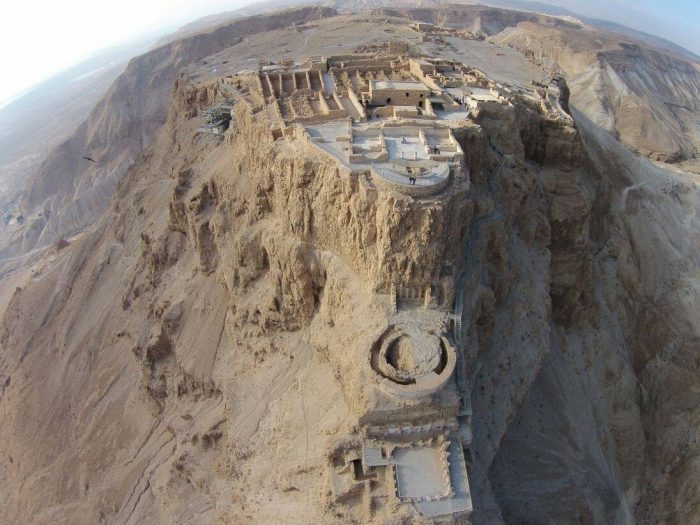
Roman fortress, a bird’s eye view. Photo Credit: The Lester and Sally Entin Faculty of Humanities
Now we have arrived at one of the most important rooms on the mountain, the Synagogue. The benches are built from stone that had been taken from other buildings. Most certainly the zealots built the synagogue while in isolation there. The entrance faced east and the building was oriented toward Jerusalem. One potshard was inscribed “Priestly tithe” and another “Hezekiah.” The synagogue had another building originally under it, most probably a stable. A hole was found in the first floor that led to a pit that turned out to be a Geniza. This is like a “holy” trash can. Jews bury documents that use the holy name of God, as it is forbidden to just throw them away.
One scroll was found in the Geniza with the two final chapters of the book of Deuteronomy. But the most incredible find was from the book of Ezekiel. The chapter in the best condition was chapter 37: The Vision of the Dry Bones! Not only did the archeologists find a 2nd Temple period synagogue, but in finding these two scrolls under the floor of the zealot’s synagogue, it proves that they cannot possibly be dated after 73 CE. Today, there is a Jewish Scribe that writes all day long in a little room on top of what was the Geniza!
As we leave the synagogue, we will pass a very well preserved Columbarium, a pigeon coup dating to the time of King Herod. Pigeons were very useful on multiple levels. Pigeons were used for sending messages back and forth. Their waste was used as fertilizer. They laid eggs and the pigeons were good to eat, as well. On top of that, they were used for sacrifices in the Second Temple period. On Masada there were two columbaria found, this is the smaller of the two.
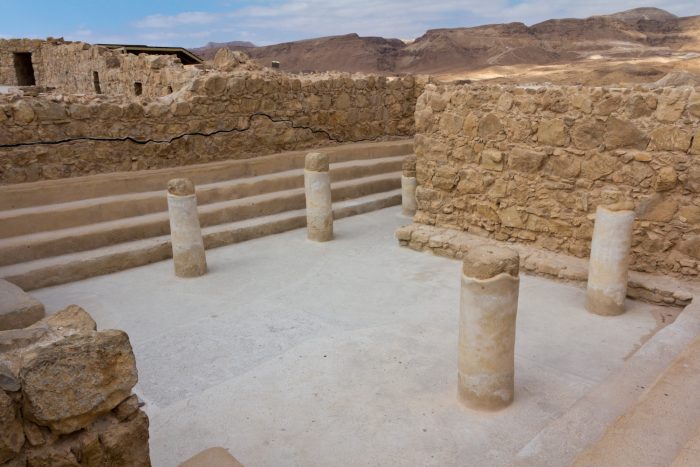
Masada ancient synagogue.
And now we arrive at the place of the culmination of the Roman siege on the Jews of Masada. It took the Romans 9 months to build a siege ramp to the top on the west side of Masada. There was a prominent white eminency of the rock, called the White Promontory, 1500 meters below the highest part of Masada. The ramp stopped short of the top of the summit by about 20 meters. They added another elevation of 50 cubits by 50 cubits (25 x 25 meters) and then they put up a siege tower on top, about 60 cubits (30 meters) high, plated with iron, used for throwing darts and stones. Under that, they moved a battering ram up the ramp directing it against the fortress wall. The battering ram broke through the outer wall. They set the secondary wooden wall that the zealots had built on fire and burned it down. And then they waited until morning to breach the walls. To their astonishment, they found 969 dead bodies strewn all over Masada. The Jews choose death over slavery. Only two women and five children survived to tell the story.
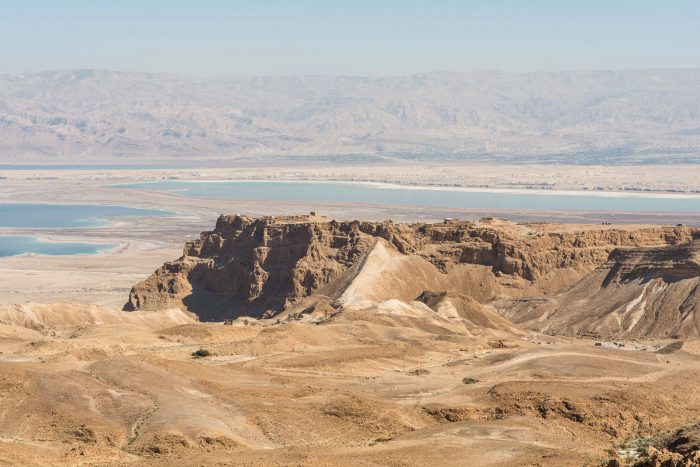
Masada the stronghold. Photo Credit: Kfar Nokdim
Masada became a symbol of courage for the emerging modern Jewish state of Israel and a pilgrimage site for youth movements. In 1949, at the end of the War of Independence, the Israeli flag was hoisted on Masada’s summit. That scroll of Ezekiel and the story of the dry bones have literally come to life. God promised the Jewish people they would come home one day. And now, nearly 2000 years after the horrific deaths of 969 men, women and children on the top of this rock, we read these words and know that God’s promise has been fulfilled!
“Then he said to me, “Prophesy to these bones and say to them, ‘Dry bones, hear the word of the Lord! This is what the Sovereign Lord says to these bones: I will make breath enter you, and you will come to life. I will attach tendons to you and make flesh come upon you and cover you with skin; I will put breath in you, and you will come to life. Then you will know that I am the Lord.’ ” Ezekiel 37:4-6
Today, we say on the top of Masada, “Am Israel Chai!” The people of Israel live! There is much, much more to see and hear about on Masada. I invite you to come and experience this incredible place one day.
Until next week, blessing from Israel.