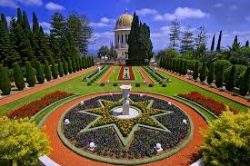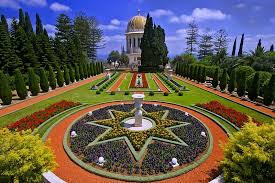
South Africans love gardens. Kirstenbosch in Cape Town is one of the finest parks in the world and the Western Cape’s Garden Route is a coastal green belt that allures and beguiles. Capetonians frequently comment there is a touch about their city beautiful stretching out from Table Mountain to the Atlantic with Israel’s Haifa, also banked on a mountain and looking out at the deep blue sea of the Mediterranean. Haifa’s mountain is the Carmel – and dominating it is the golden-domed Shrine of the Báb – the resting place of the Prophet-Herald of the Bahá’í Faith – surrounded by one of the finest gardens in the entire Middle East.
While most the religious sites in Israel relate to the world’s three main religions – Judaism, Christianity and Islam – the Bahá’í Gardens is the sacred ground for a less well known faith and well worth a visit, not only to enjoy its stunning beauty but also to explore “something completely different,” says tour guide Henry Lochoff, a former South African from Johannesburg. “I can’t ever remember taking tourists to the Bahá’í Gardens and them not leaving star-struck by the experience – irrespective of their religion. I believe it’s the combination of its beauty, the serenity and meeting the people who work there. They are all volunteers from abroad – from the guards to the gardeners – all Bahá’í faithful. They could be doctors, plumbers, lawyers or electricians – and they volunteer to work at the Bahá’í, provided only board and lodging. And the fascinating thing, they have to register to volunteer years in advance – that is how popular it is.” And it is no less popular to tourists attracting over half a million visitors a year. Inscribed on UNESCO’s World Heritage List since 2008, the Bahá’í Gardens in Haifa leaves an indelible impression on visitors. Many return again and again to experience the changing seasons and relive its serene tranquility.
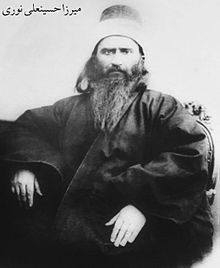
Bahá’u’lláh
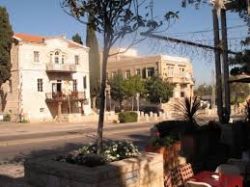
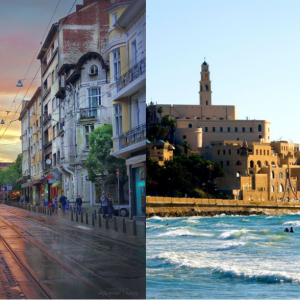
German Colony, Haifa
A Sense for All Seasons
“These holy Manifestations have been as the coming of springtime in the world…For each spring is the time of a new creation…” Abdu’l-Bahá, eldest son of Bahá’u’lláh. Seasons appear to be integral both physically and spiritually to the Bahá’í. “They believe that divine truths are revealed over time by messengers like the arrival of spring bringing with it the colour and vigour of the new season and with it the promises for a better future,” explains Lochoff. Emblazing this concept, much of the flora in the gardens are replaced each season so as there are diffident colours and smells throughout the year to delight the senses. The messengers that include Abraham, Moses, Jesus, Muhammad, as well as Dharmic ones of Krishna and Buddha, “each prophesized the messenger to follow with the last one being Bahá’u’lláh (Glory of God), the founder of the Bahá’í Faith. In this way, the Bahá’í Faith treats religious history as unfolding through a series of divine messengers, each of whom established a religion that was suited to the needs of the time. Humanity is understood to be in a process of collective evolution, “and the needs of the present time are to achieve peace, justice, education for all, equality between the sexes and unification on a global scale where there are no borders and divisions.” Who would argue that the Bahá’í is not a beautiful religion “and is this not a beautiful sight,” asserts Lochoff as all eight in his group, stood at the foot of the Carmel in the renovated German Colony and looked up Mount Carmel at the Bahá’í Gardens with the golden dome shimmering against the bright blue Mediterranean sky. The view was captivating.
Shrine & Shine
If Jerusalem is instantly recognized by the golden dome that crowns the Dome of the Rock, then so too is Haifa with the golden-domed Shrine of the Báb – the resting place of the Prophet-Herald of the Bahá’í Faith. Its visual dominance of the vista beckoned us and we began walking up the hill, with our guide explaining the history of the religion that has over seven million followers 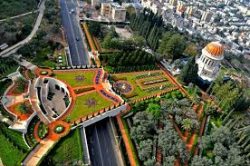 worldwide. “It all starts on the evening of 22 May 1844, when Siyyid `Alí-Muhammad in the Iranian city of Shiraz proclaimed that he was “the Báb” (“the Gate”). He later claimed the exalted position of ‘Mahdi’, and the Twelfth Imam of Shi`a Islam. Inevitably as the Báb’s teachings spread throughout Iran, the Islamic clergy saw him as a threat, and his followers were persecuted. There was unrest which brought in the military and finally the Báb himself was imprisoned and executed in 1850. That might have been the end of the story were it not for Mírzá Husayn `Alí Núrí, a Báb follower. He too was arrested and imprisoned and in 1853, while incarcerated in the dungeon of the Síyáh-Chál in Tehran, he received ‘the calling’ that he was the one prophesized by the Báb and took the title of Bahá’u’lláh. That ‘calling’ soon led to him being expelled from Tehran to Baghdad, still in the Ottoman Empire. Following further banishments arising out of tensions caused by his presence, in 1868 Bahá’u’lláh was banished one final time to the Ottoman penal colony of Akko, north of Haifa. Although officially under house arrest, the Turkish authorities allowed him to travel. On one outing, he visited Mt. Carmel and decided it was the ideal spot for the tomb of Siyyid Ali-Mohammed, whom Bahá’u’lláh revered as the Bab. And so it was that the Bab’s remains were brought to Haifa and laid to rest in the tomb, and which later topped with the golden dome, has become Haifa’s iconic landmark.
Through the Looking Glass
Entrance into the gardens is free and visitors can begin exploring from either the bottom or top end. Considering there are roughly 1,700 steps, most visitors, as well as the official tours, start from the top. We however entered from the bottom having enjoyed the straight uphill walk along the main road of the picturesque German Colony. With their carefully manicured shrubs, profusion of flowers, and elegant trees, the 19 terraces appear like a garden in a fairytale. As an Oxford woman student in our group from the UK commented, “I feel like Alice in Wonderland having stepped 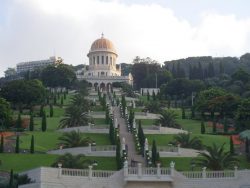 through the Looking Glass.” We stopped and spoke to a young man tendering a magnificent bed of flowers. A volunteer from Frankfort in Germany he revealed that his father and his father before him were all Baha’is’, “So I have known no other religion.” We were intrigued why there were specifically 19 terraces and not say 20 “which would have been typically western,” as another in our group commented. The ‘gardener’ explained “that the number 19 is symbolic of completeness, perfection and unity. Our year is made up of 19 months, with 19 days each. Also, the Báb and his disciples formed a group of 19 and there were 19 Apostles of Bahá’u’lláh.” It made perfect sense as did everything we looked at – it appeared as if we were gazing upon perfection. The more formal part of the terraces run down the center, which is flanked on either side by “wilder” swathes of trees and shrubbery. Fine hand-carved stonework graces areas throughout the terraces. A system of fountains and water channels runs down the entire length of the terraces, which are brilliantly illuminated at night. Harmony pervades. Indeed, a large stone bridge crosses over Sderot Ha’ Tsionut, one of Haifa’s main thoroughfares connecting the lower and upper parts of the city. Standing upon it, you hardly notice the traffic beneath. The Terraces of the Bahá’í Faith, also known as the Hanging Gardens of Haifa, extends almost a kilometer up the side of Mount Carmel, covering some 200,000 square meters of land. The gardens are linked by a set of stairs flanked by twin streams of running water, cascading down the mountainside through the steps and terrace bridges. The gardens have elements of the Persian gardens of Shiraz in Iran, the Nishat Bagh Gardens of Kashmir, India as well as the emerald delight of an English garden. Although located in central Haifa, once having entered the gardens, the hustle and bustle of the big city is furthest from the mind and I was reminded of the memorable line from English poet Thomas Grey: “Far from the madding crowd’s ignoble strife…” Here there was no “madding crowd” nor, “ignoble strife” only peace, tranquility and beauty.
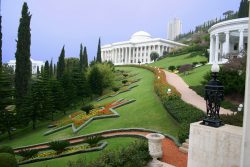
Baha’i World Centre – arc from archives
Heart of Haifa
Further up we walked until we came upon the Bahá’í World Centre, the spiritual and administrative heart of the Bahá’í community. There we saw and learnt more about the beautiful Shrine of the Báb and the Seat of the Universal House of Justice, where the international governing council of the Báb community sits. A large magnificent white building with columns, it is here where the House of Justice consults on the affairs of the worldwide community, meet dignitaries and pilgrims, and houses the offices of the Bahá’í World Centre. Also located here were the International Teaching Centre Building, the Centre for the Study of the Texts and the International Bahá’í Archives. In His book of laws, Bahá’u’lláh instructed the Universal House of Justice to exert a positive influence on the welfare of humankind, promote education, peace and global prosperity, and safeguard human honor and the position of religion. All quite mesmerising, I stood marveling at this majestic sight, marveling no less at the majestic message it sends to the world. The Báb who was executed for his beliefs in a land far away, could be proud of how far his “message” has come and that his vision enjoys prime position in the heart of Haifa. For a religion based on the words of ‘messengers’, I left this wonderful place with a simple ‘message’: “I shall return.”