*Beverley Price chatted to Israelink
Revealing the artistic talents of African Jewry through the journey of a South African jeweller
Jews and Africa have a long history.
Preceding the Jewish migration of the 19th century from Europe to South Africa, which many people are familiar with, there were Jews settled in Africa going back thousands of years.
This, few people know about.
These are the Jews of Ethiopia, often thought to be the descendants of a liaison between King Solomon and the Queen of Sheba.
That romantic and colourful genesis finds expression in their descendant’s art now on exhibit in South Africa.
A Taste of Honey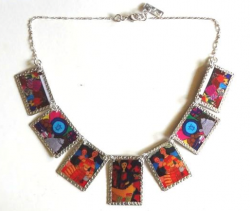
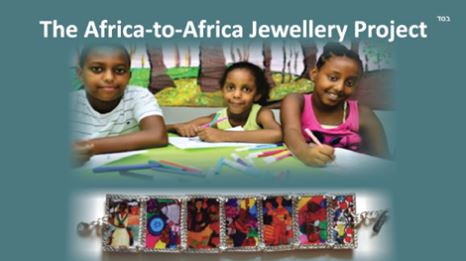
In a converted bomb-shelter in Hadera, a city about 45 kilometres north of Tel Aviv, art is flourishing in an afterschool centre for Ethiopian children called Maksam. The children are all descendants of those rescued from Ethiopia in two major operations – in the 1980s in Operation Moses, and in the 1990s in Operation Solomon.
The word ‘Maksam’ is Amharic Ethiopian and refers to the process of ‘bees passing from flower to flower, collecting nectar and producing honey‘.
The ‘sweetness’ of this ‘honey’ is now being savoured in South Africa.
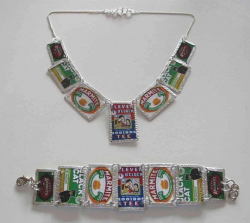
Where it began – South African original colourful brands
Absolutely Priceless
In 2014, Beverley Price came across a flyer in Johannesburg, showing images of some of these young children’s paintings. “They were an amalgam of Israeli interpretation of Jewish and Ethiopian themes drawing from the narrative of the Old Testament as well as nostalgia of the life of their ancestors in Ethiopia.”
The art instantly resonated with this South African jeweller and sculptor.
There was good reason!
“In 1983 I left apartheid South Africa, amoral and terminal, and made Aliyah (immigration to Israel) which literally means ‘ascending’ and this is what it felt like.”
Initially living on a kibbutz (rural collective community) in northern Israel, she later moved to Jerusalem, where she re-trained as a jeweller. Beverley, then moved to London for three years to work and study further, which included enamelling and silversmithing, and in the early 1990’s, “I returned ‘home’ to Israel where I shared a studio with other jewellers in Jerusalem.”
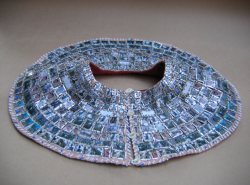
Large Mandela neckpiece using images from the chronology of his life.
Then, “when Mandela was released I could not resist returning to South Africa. I wanted to experience the privilege of living under Mandela’s presidency.”
However, in 1995, the old had not quite given way to the new and “I found Johannesburg still ‘thick’ in Apartheid. It was more than just residue – it was stifling, and I took myself off to live in Ixopo in rural KwaZulu Natal. There I opened my own studio near a Zulu village called Cibini (Tsibini) and learned to speak isuZulu.”
Journey of an Artist
In Ixopo, “I was inspired by the local Zulu culture and invented a method of making jewellery from foiled pictures.”
Then in 1999, Beverley returned to Johannesburg “girded with my archetypal African experience, which remains the backbone of my life as a post-Apartheid South African. I felt those years living at close quarters with the Zulu, were some kind of an amends for simply being a ‘White person’ during Apartheid times.”
She went back to Wits University in 2000 “to do a post-graduate fine arts degree and was encouraged to take my jewellery invention to higher levels. I created hybrid art work – crossing the indigenous African and the western European divide. These were heady times in South Africa, and we lived with great hopes for the future. My work was exhibited internationally and bought into private and national fine art collections in South Africa.”
Following a suggestion to teach her technique to South African women who were previously disadvantaged, Beverley began in 2001, passing on her skills to women in Alexandra, Johannesburg.
This was a new dawn.
“Our clients over the years have included the Nobel Peace Centre in Oslo, the British Museum Shop in London, the Octopus stores in the UK, the International Centre for Photography in New York, and the National Gallery of Victoria, Melbourne. We have worked with corporate clients including South African Tourism and Fashion Week. Our South African retail clientele have included Art Africa, Kim Sachs Gallery, the Moyo shops and Heartworks in Cape Town. We used iconic South African images in the jewellery, including those of Nelson Mandela, Drum Magazine cover pin-ups and popular South African brands. I collaborated with Jurgen Schadeberg the Apartheid photographer, using his images such as those of Nelson Mandela at Robben Island, for the jewellery.”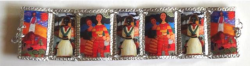
Post Mandela
“All flourished until Mandela passed away. At this point permission was withdrawn for the use of his image commercially, despite that the work and incomes that had been generated went to many post-Apartheid enterprises. I regard Mr. Mandela as a ‘national heritage treasure‘. It was a sad day indeed when I met with the Nelson Mandela Foundation copyright lawyer to hear the news. Synchronously, we have seen since then, our South Africa’s demise into destructive and selfish politics. I have personally experienced a loss of idealism and optimism while watching our people mercilessly aggregate wealth at the expense of the masses in our country.”
“Children of Israel”
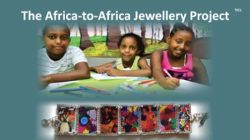 Upon seeing the Ethiopian Israeli children’s paintings in 2014, Beverley’s hopes soared again.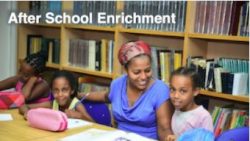
She felt these colourful images would work perfectly in her jewellery. “Some of the children’s paintings represent a uniquely African understanding of God’s contract and promise of Israel to the Jews for eternity via Abraham and Moses. For example, the biblical characters are black people. As a Jew, I had been looking for Jewish content for years. Here was a perfect match between different African Jews! My African jewellery format with their African images. We had found each other via Israel and I had the vision of creating uniquely African-Israeli Jewish products and artwork.”
This African cross-pollination between a South African jeweller and Ethiopian Jewish artists, has brought to fruition the meaning of the word “Maksam”. “We are Jews with different cultural origins on the African continent who have connected by virtue of our shared heritage – Israel and its centrality in our Jewish lives. I remain a Jew who lives in South Africa, and they live in Israel.”
Looking to Tomorrow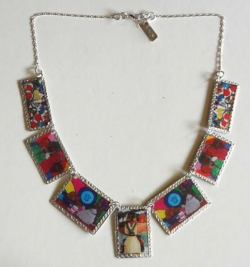
“Our vision for the Africa-to Africa Jewellery Project is to create an artisanal community in Hadera which mirrors the group I have in South Africa. My South African ladies and I will go and teach our jewellery techniques to talented Ethiopian Israeli women – perhaps to the mothers of the children. In this way, the production of our range can occur from start to finish in Israel, using originally South African know-how.”
Beverley visited Israel in June 2017 and met the managers of the Maksam community including Yael Sela and Yehudit Benjamin, the children, and some of the teachers. “I saw more of their paintings. The highlight of my visit was being able to converse in Hebrew to these Jewish Ethiopian Israeli children. This was not isuZulu in KwaZulu-Natal, but Hebrew in Hadera, Israel. And all Jews!
In Zulu we speak of “Ubuntu” and in Hebrew “Beyachad” – this project is a perfect example of that.”
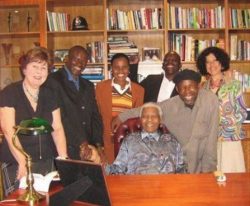
History. With artists and Mr Mandela, after exhibiting at Constitutional Hill, Johannesburg on the subject of Mandela’s life.
*See – https://www.facebook.com/africatoafricajewellery/